3.0 Due Process Handbook – Discussion of Revised Due Process Handbook
UK ENDORSEMENT BOARD 23 SEPTEMBER 2022 AGENDA PAPER 3
Project Type: UKEB Set-up Project Scope: N/A
Executive Summary
Purpose of the paper
This paper provides the Board with a summary of the remaining matters identified by respondents on the draft Due Process Handbook (the "Handbook") that the Board did not have time to discuss at the July 2022 meeting.
Summary of the Issue
The Handbook was issued for comment on 21 February 2022 and was open for comment until 6 June 2022.
The Appendices to this paper include a summary of:
- the remaining main matters identified by respondents on the Handbook (Agenda paper 3 Appendix 1). We are asking the Board for its comments which will help us develop a revised version of the Handbook that we will bring for discussion, review and approval at the October 2022 meeting;
- the other non-substantive matters identified by respondents on the Handbook (Agenda paper 3 Appendix 2) we are also asking for comments, if any.
A copy of the draft Handbook that was published for public comment can be found here.
Decisions for the Board
We are not asking the Board to make any decisions at this meeting. Board members are only asked for their comments on the main matters identified in Appendix 1 and comments on the non-substantive matters in Appendix 2.
Recommendation:
Board members consider and comment on the proposed approach and provide comment on proposed actions indicated.
Appendices
| Appendix 1 | Comments summary– Review of (remaining) comments received |
| Appendix 2 | Other non-substantive matters |
Introduction
1The UKEB published for public consultation its (draft) Due Process Handbook (the "Handbook") on 21 February 2022. The draft Handbook was open for comment until 6 June 2022. The Board received 6 comment letters1.
2The UK oversight body (FRC) provided additional feedback via email on 14 June 2022. The FRC's feedback was similar in nature to the other respondents' comments and was addressed as part of our analysis in Appendix 1 of Agenda Paper 3 (July 2022). The feedback received was also shared with Board members in full.
3After the July 2022 Board meeting, we received additional feedback from the FRC via email on 19 August 2022. This feedback is on issues discussed at the July Board meeting, as well as on the remaining issues to be discussed at this September 2022 Board meeting. This additional feedback has also been shared with Board members in full.
4We have addressed all the comments sent by the FRC2, either as part of Agenda Papers 3.1–3.2 (for this September 2022 meeting) or in the revised version of the draft Handbook that we will bring for discussion and approval at the October 2022 Board meeting.
Issues discussed at the July 2022 meeting
5At its meeting on 18 July 2022, the Board began the discussion of the main (substantive) issues identified by respondents and provided comments on the Secretariat's preliminary assessment and planned drafting amendments. During that meeting, Board discussed Issues 1–5 in Appendix 1 of Agenda Paper 3 (July 2022) shown in the table below.
| Substantive issues already discussed by the Board at the July 2022 meeting | |
|---|---|
| 1A–1B | Voting process for adoption decisions |
| 2A–2D | UKEB workplan–priorities, review and discussion |
| 3 | Milestones that should be mandatory |
| 4 | Considering whether to "pursue” a non-mandatory milestone should not be "optional" |
| 5 | Instances where consultation periods can be shortened |
Issues that will be discussed at this meeting
6At the September 2022 meeting, the Board will continue its discussion of the remaining key issues identified from the consultation feedback (Issues 6–13). These issues are shown in the table below:
| Issue(s) in this paper | Remaining substantive issues | Paragraphs in this paper |
|---|---|---|
| 6 | Circumstances for carrying out "minimum outreach activities" for endorsement projects | 44–48 |
| 7A–7C | DECA content | 49–62 |
| 8 | Timeframes for completing endorsement activities | 63–64A |
| 9A–9E | Activities for meeting the objectives of thought leadership and the research programme | 65–81 |
| 10A–10C | Requirements for carrying out post-implementation reviews | 82–99 |
| 11A–11B | Supporting the work of the IFRS Interpretations Committee | 100–106 |
| 12 | Quorum requirements for advisory groups and frequency of meetings | 107–108 |
| 13A–13D | Other issues not addressed in the Handbook | 109–121 |
Structure of the papers
7The papers for this meeting are:
- Agenda Paper 3.1 This paper reproduces most of the content from Appendix 1 of Agenda Paper 3 (July 2022) on the remaining matters identified by respondents except for the following:
- Issue 7: We slightly edited paragraphs 54–55 and 58 (Issue 7A) and paragraph 61 (Issue 7C) for clarity. Paragraph 62 (Issue 7C) was also revised to convey our preliminary assessment more clearly.
- Issue 8: We added new paragraphs 63A and 64A to reflect the Board's views at the July 2022 meeting.
- Issue 9: The issue titles in paragraphs 65(c)–(e) have been slightly edited for clarity.
- Issue 10: We revised this section to convey the issues raised by respondents and our preliminary assessment more clearly. In addition, we have put together a proposal of a revised section 8 "Post-implementation reviews" of the draft Handbook in Annex 1 of this paper (see pages 22–28 of this paper).
- Agenda Paper 3.2 This paper reproduces most of the content from Appendix 2 of Agenda Paper 3 (July 2022) 'summary of other non-substantive matters identified by respondents and planned actions'. We made minor revisions to some of the comments received and/or to our planned actions to convey the issues raised by respondents and our response more clearly.
8We are not asking specific questions to the Board, but any feedback on the matters covered in either of those papers (Agenda Papers 3.1 and 3.2) is welcome.
Next steps and timeline
9At the July 2022 meeting some Board members expressed a desire to maintain (or to have a date that is close to) the original publication date for the final version of the Due Process Handbook3. To meet this objective, we have:
- compressed the approval timeline for the revised draft of the Handbook.
- added a couple of new steps to give the Board an opportunity to review the final version of the final Due Process Handbook before it is published.
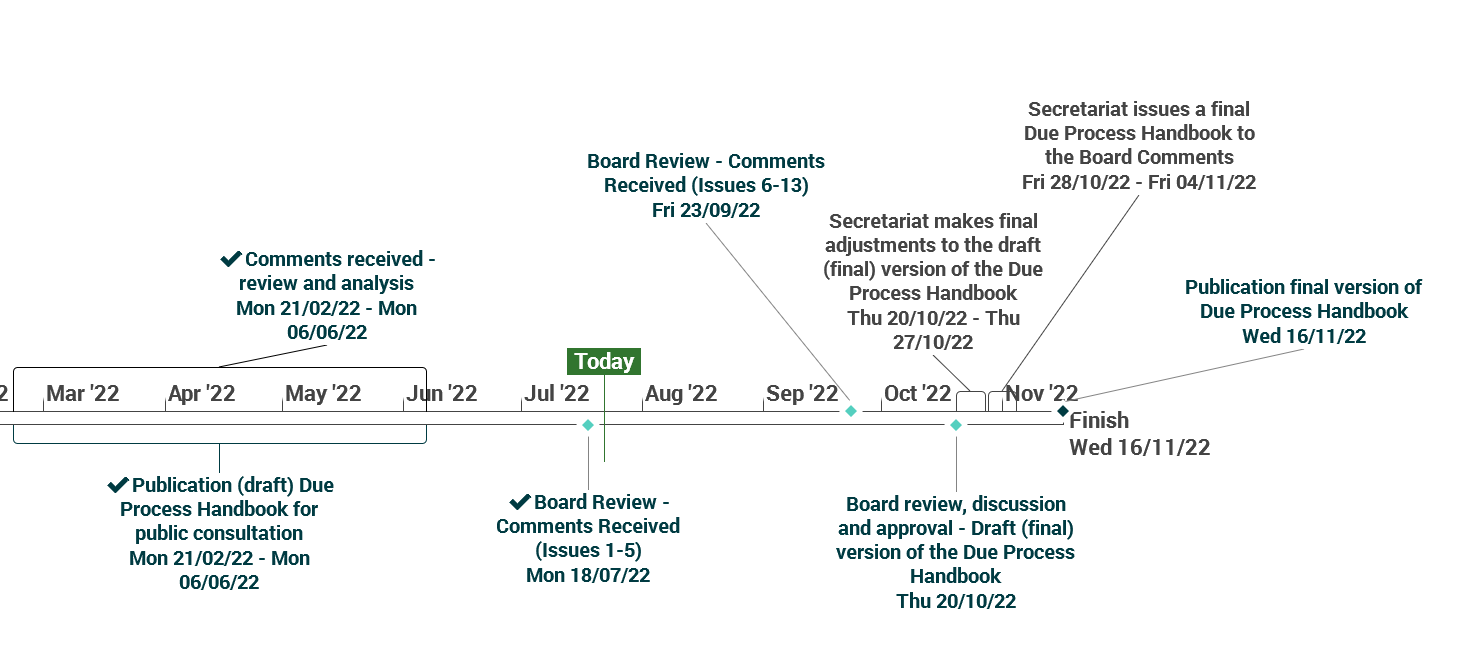
10Subject to the comments we receive at this meeting and any amendments/additions required by the Board, we plan to bring for Board review, discussion and approval a revised draft of the Handbook at the October 2022 meeting. The revised planned next steps are set out below.
Timeline
| Date | At a public Board meeting: | Status |
|---|---|---|
| 18 July 2022 | Feedback summary–Main (substantive) matters identified discussion (Issues 1–5) | Completed |
| 23 September 2022 | Feedback summary–Main (substantive) matters identified discussion (Issues 6–13) | This meeting |
| 20 October 2022 | Board review, discussion, and approval of draft (final) version of the Due Process Handbook | To be completed |
| 21–27 October | Secretariat makes any final adjustments to the draft (final) version of the Due Process Handbook derived from the comments received at the October 2022 meeting | To be completed |
| 28 October 2022 | Secretariat issues a final revised version of the Due Process Handbook for final review by the Board Comments due by Friday 4 November 2022 | To be completed |
| Mid-November 2022 | Publication of final Due Process Handbook |
High Level Plan
Appendix 1: Comments summary–Review of (remaining) comments received
Purpose
1This paper provides the Board with a summary of the remaining matters identified by respondents in relation to some of the sections in the (draft) Due Process Handbook (the "Handbook").
2This paper reproduces the content from Appendix 1 of Agenda Paper 3 (July 2022) except for the following:
- Issue 7: We slightly edited paragraphs 54–55 and 58 (Issue 7A) and paragraph 61 (Issue 7C) for clarity. Paragraph 62 (Issue 7C) was also revised to convey our preliminary assessment more clearly.
- Issue 8: We added new paragraphs 63A and 64A to reflect the Board's views at the July 2022 meeting.
- Issue 9: The issue titles in paragraphs 65(c)–(e) have been slightly edited for clarity.
- Issue 10: We revised this section to convey the issues raised by respondents and our preliminary assessment more clearly. In addition, we have put together a proposal of a revised section 8 “Post-implementation reviews” of the draft Handbook in Annex 1 of this paper (see pages 22–28 of this paper).
3For the matters identified below we describe the issue, provide a preliminary assessment and we ask the Board for its initial thoughts on the feedback received.
| Issue(s) in this paper* | Remaining substantive issues | Paragraphs in this paper |
|---|---|---|
| 6 | Circumstances for carrying out "minimum outreach activities" for endorsement projects | 44–48 |
| 7A–7C | DECA content | 49–62 |
| 8 | Timeframes for completing endorsement activities | 63–64A |
| 9A–9E | Activities for meeting the objectives of thought leadership and the research programme | 65–81 |
| 10A–10C | Requirements for carrying out post-implementation reviews [revised section] | 82–99 |
| 11A–11B | Supporting the work of the IFRS Interpretations Committee | 100–106 |
| 12 | Quorum requirements for advisory groups and frequency of meetings | 107–108 |
| 13A–13D | Other issues not addressed in the Handbook | 109–121 |
*Issues 1–5 were discussed at the July 2022 Board meeting and are not included in this paper.
The following section reproduces paragraphs 44–53, 56–57 and 59 (for Issues 6–7B) of Agenda paper 3.1 (July 2022). Paragraph 54–55 and 58 were edited for clarity.
Issue 6– Circumstances for carrying out "minimum outreach activities" for endorsement projects
44Paragraphs 6.21(a)−(b) describe the situations in which the UKEB carries out minimum outreach activities for endorsement activities (as it was discussed in Issue 51 these situations are the same for shortening the comment period for a DECA). These are:
6.21 (...)
- Where amendments to international accounting standards are minor and meet the criteria for annual improvements or for narrow-scope amendments; and
- Where there is limited time to consult e.g. for an urgent narrow-scope amendment issued by the IASB where it shortens the period between publication date and effective date of the amendment and the amendment is urgently required to be adopted by entities.
Matters raised
45Respondents agreed with the circumstances mentioned in paragraph 6.21 for carrying out minimum outreach activities for endorsement projects. One respondent thought that the amount of outreach undertaken should also be determined by how successful the UKEB has been at the influencing stage. For example, a limited amount of outreach may be appropriate if extensive stakeholder consultation was undertaken (while the Standard was being developed) and if the issues raised had been shared with the IASB and acted upon.
46Another respondent recommended that paragraph 6.21 includes an explicit rebuttable presumption that outreach beyond the minimum level is to be undertaken as part of an endorsement process.
Staff view
47We disagree that “the extent of stakeholder consultation during the development of a new or amended Standard” should be added as a new circumstance for determining minimum outreach activities for endorsement activities. The endorsement and adoption phase of a project has a different objective and different criteria that need to be addressed.
48We think that adding an explicit rebuttable presumption that outreach beyond the minimum level is to be undertaken as part of an endorsement process is not necessary because paragraph 6.23 requires the Secretariat to highlight in the Project Initiation Plan "the amount of outreach undertaken, together with the rationale”.
Issue 6. Questions for the Board
- Does the Board agree with our recommendation in paragraph 47 that “the extent of stakeholder consultation during the development of a new or amended Standard" does not need to be added as a new circumstance for determining minimum outreach activities for endorsement activities?
- Does the Board agree with our view in paragraph 48 that adding an explicit rebuttable presumption that outreach beyond the minimum level is to be undertaken as part of an endorsement process is not necessary?
Issue 7–DECA content
49Paragraph 6.27 of the Handbook states that the main sections of the DECA are as follows (we are reproducing an extract of this paragraph):
6.27
- Introduction: legislative framework and approach to the assessment: (...)
- Rationale for the new or amended international accounting standard, i.e. summary background, context and objectives and main accounting requirements;
- Technical criteria assessment: (...)
- Whether use of the new or amended standard is likely to be conducive to the long term public good in the UK (SI 2019/685 Regulation 7(1)(b)), including: (...)
Matters raised
50Some respondents raised the following comments:
- The content of the DECA should be focused on UK-specific issues (Issue 7A)
- The technical accounting criteria in the DECA should be aligned with the IASB's 2018 Conceptual Framework (Issue 7B)
- The assessment on long-term public good should be expanded to include the impact of non-endorsement (Issue 7C)
51We address these issues separately in paragraphs below.
Issue 7A: The content of the DECA should be focused on UK-specific issues
Matters raised
52One respondent thought that a DECA should not be a document that re-deliberates and re-debates specific issues that have already been considered by the IASB and that instead, it focuses on UK-specific issues that were not adequately addressed by the IASB.
53This respondent also observed that the lengthy IFRS 17 Insurance Contracts DECA is not taken as a template going forward.
Staff view
54We disagree with the respondent's suggestion to focus the DECA on UK-specific issues only. The content of the DECA is derived from the need to assess the standard or amendment against the requirements in the statutory instrument SI 2019/685.
55The IFRS 17 DECA was mainly focused on UK-specific issues – the only exception being the consideration of the assessment of annual cohorts. This issue was of primary concern to the EU and was considered in the UKEB's IFRS 17 DECA due to the implications for level playing field for UK companies with businesses in Europe and the implications for the UK's long-term public good assessment. We further observe that the length of the DECA will vary depending on the nature, scope or complexity of the new (or amended) Standard. Consequently, we do not think that any further action is needed in this respect.
Issue 7A. Question for the Board
- Does the Board agree with our conclusion in paragraph 55 that the focus of the DECA should not change?
Issue 7B: The technical accounting criteria in the DECA should be aligned with the IASB's 2018 Conceptual Framework
Matters raised
56One respondent recommends the alignment of the technical criteria for endorsement and adoption (in paragraph 6.27(c)(i) of the Handbook) with the qualitative characteristics in the revised Conceptual Framework issued by the IASB in March 2018. This is because:
- the UKEB's technical criteria give equal weight to the qualitative characteristics of financial information (i.e. understandability, relevance, reliability and comparability); whereas,
- the IASB's revised 2018 Conceptual Framework establishes a distinction between fundamental characteristics (relevance and faithful representation) and enhancing qualitative characteristics (comparability, verifiability, timeliness, and understandability).
57We reproduce an extract of paragraph 6.27(c)(i) below:
6.27
- Technical criteria assessment:
- whether the standard meets the criteria of relevance, reliability, comparability and understandability required of the financial information needed for making economic decisions and assessing the stewardship of management (...)
Staff view
58We disagree with the respondent's suggestion. The descriptions in the DECA are based on the qualitative characteristics that are part of the criteria for endorsement and adoption of IFRS in the EU's IAS Regulation (1606/2002), and were, subsequently, on-shored into the UK via SI 2019/685. During that on-shoring process Parliament did not consider it necessary to align the technical criteria with the updated characteristics in the IASB's 2018 Conceptual Framework. However, the legislation has not granted the UKEB the ability to revise the adoption criteria set by Parliament. Any such change therefore must be approved by Parliament. We observe that the same respondent addressed this same point in its response to the IFRS 17 DECA2. The IFRS 17 Feedback Statement observed that:
"The technical accounting criteria assessment was completed in accordance with the criteria set out in SI 2019/685, which is separate from the IASB's Conceptual Framework and does not require or indicate a weighting between criteria. On this basis no amendment was made in the final ECA for this point"
59Based on the above, we do not recommend the Board take any further action in this respect.
Issue 7B. Question for the Board
- Does the Board agree with our conclusions in paragraphs 58–59 that the technical accounting criteria used for endorsement and adoption should not be changed?
The following section reproduces paragraph 60 of Agenda paper 3.1 (July 2022). Paragraph 61 was slightly edited for clarity. Paragraph 62 was revised to convey our preliminary assessment more clearly.
Issue 7C: The assessment on long-term public good should be expanded to include consideration of the impact of non-endorsement [Revised section]
Matters raised
60Paragraph 6.27(d) of the Handbook explains that the assessment of whether use of the new or amended standard is likely to be conducive to the long term public good (LTPG) includes an assessment of:
6.27(d)
- whether the use of the standard is likely to improve the quality of financial reporting;
- the costs and benefits that are likely to result from the use of the standard; and
- whether the use of the standard is likely to have an adverse effect on the economy of the UK, including on economic growth.
61That section of the Handbook reproduces the requirements set out in the legislation (SI 2019/685). Two respondents were of the view that the LTPG assessment in paragraph 6.27(d) should additionally include consideration of the impact of non-endorsement (in full or in part).
Staff view
62Generally, the adoption decision is focused on the implications of adoption of the standard for use in the UK. As such consideration of non-endorsement is already part of the endorsement work and is assessed as part of the economic assessment work. We therefore do not think that this needs to be specified separately.
Issue 7C. Question for the Board
- Does the Board agree that no changes to the Handbook are necessary on this point as explained in paragraph 62?
The following section reproduces paragraphs 63–64 of Agenda paper 3.1 (July 2022). We included new paragraphs 63A and 64A to reflect the Board's views at the July 2022 meeting.
Issue 8– Timeframes for completing endorsement activities
Matters raised
63A few respondents observed that the Handbook does not mention detailed timeframes for completing endorsement and adoption projects. They believe that including such timeframes is important because it would provide certainty to UK markets and would allow UK companies to prepare for the implementation of a new or amended Standard.
63AIn addition, and as explained during the discussion of Issue 2B “Endorsement projects should always be top priority”4, two of those respondents also observed that the UKEB should aim to adopt standards with the same effective date as that required by the IASB and suggested that the effective date of a new or amended standard be included as one of the factors for prioritising technical projects in its workplan.
Staff view
64The Handbook does not currently require the UKEB to complete the endorsement or adoption of a Standard under a certain timeframe. However, paragraph 6.15(a) (Section 6: "Project initiation Plan") requires the Secretariat to provide a description of the proposed timeline, which we think should be sufficient. Therefore, we do not propose adding any further requirements in this respect.
64AIt should also be noted that in response to the feedback received and derived from the July 2022 Board discussion of Issue 2B, the Board agreed to add in the Handbook "the need to align with the IASB's effective date for a new or amended standard" as an additional circumstance for prioritising technical projects in its workplan.
Issue 8. Question for the Board
- Does the Board agree with our recommendation in paragraph 64 not to add any requirements in the Handbook on timeframes for completing endorsement activities?
The following section reproduces paragraphs 65–81 (for Issue 9) of Agenda paper 3.1–July 2022. The issue titles in paragraphs 65(c)–(e) have been slightly edited for clarity.
Issue 9–Activities for meeting the objectives of thought leadership and the research programme
Matters raised
65Some respondents suggested that the following issues should be clarified in Section 7 of the Handbook:
- Timing and frequency of engagement with UK stakeholders (Issue 9A)
- Developing the UKEB’s “own views” when 'leading the UK debate' is misleading (Issue 9B)
- The UKEB's representatives on IASB's consultative groups (Issue 9C)
- The UKEB's engagement with bodies in other jurisdictions (Issue 9D)
- The research programme and its “problem-solving orientation” (Issue 9E)
66We address these issues separately in paragraphs below.
Issue 9A: Timing and frequency of engagement with UK stakeholders
Matters raised
67Paragraphs 7.2 and 7.3 in the Handbook explain how the UKEB carries out the objectives to "lead the UK debate on international accounting standards" and to “proactively participate in the development of global accounting standards". One respondent observed that those paragraphs give no indication on the timing and frequency of the UKEB's engagement with UK stakeholders. This respondent thinks that this additional information would help manage stakeholder expectations as to the frequency and method of engagement.
68Another respondent observed that smaller entities (i.e. entities that are not listed) sometimes do not have the resources to engage with the IASB directly, and therefore the UKEB should develop a process to engage with these stakeholders directly.
Staff view
69The level of engagement with UK stakeholders will be project-specific and will depend on the nature, scope or complexity of the project. One of the requirements in the Project Initiation Plan (paragraph 7.18(b) of the Handbook) is to provide “a description of milestones and planned activities that will be undertaken to achieve those milestones...". Therefore, this plan will give stakeholders an indication on the timing and frequency of the UKEB's engagement with UK stakeholders, including about its engagement with UK stakeholders that do not engage with the IASB directly. Additionally, we are setting-up advisory groups which will also provide regular input to the Board. Consequently, we do not recommend the Board take any further action in this respect.
Issue 9A. Question for the Board
- Does the Board agree with our conclusion in paragraph 69 that the Project Initiation Plan provides stakeholders an indication on the timing and frequency of the UKEB's engagement with UK stakeholders and that no further action is needed?
Issue 9B: Developing the UKEB’s “own views” when 'leading the UK debate' is misleading
Matters raised
70Paragraph 7.2(a) of the Handbook states that the UKEB leads the UK debate on international accounting standards and reporting by (emphasis added):
7.2(a) actively engaging and collaborating with UK stakeholders on areas that concern UK stakeholders during the process of developing its own views, with the aim of building robust and evidence-based recommendations. (...)
71One respondent observed that the meaning of "its own views” in paragraph 7.2(a) is ambiguous and potentially misleading as it implies that the UKEB will be interpreting Standards.
Staff view
72We do not agree with the respondent. We consider that the phrase “during the process of developing its own views” is an intrinsic part of our thought leadership guiding principle and does not relate to interpreting standards.
Issue 9B. Question for the Board
- Does the Board agree with our recommendation in paragraph 72 not to change the wording in the Handbook?
Issue 9C: The UKEB's representatives on IASB's consultative groups
Matters raised
73Paragraph 7.4(b) of the Handbook states that the UKEB directly influences the IASB Board and maintains a global presence on the international financial stage by (emphasis added):
7.4(b)
- maintaining effective relationships, communication and presence with the IASB and other national standard-setters subject to available UKEB resources.
- (...)
74One respondent suggested that the UKEB should provide information about UK representatives attending IASB's consultative groups on the UKEB website for additional transparency.
Staff view
75We agree with the respondent's suggestion to publish information about UKEB representatives to the IASB's consultative groups on the UKEB website, for example, the Chair is a member of ASAF. As to other UK people being a member of an IASB consultative group, we may publish such information if it is not contrary to the GDPR rules relating to the publication of personal information.
Issue 9C. Question for the Board
- Does the Board agree with our view in paragraph 75 that information relating to UKEB representatives to the IASB's consultative groups should be on the UKEB website (unless it is contrary to the GDPR rules relating to the publication of personal information)?
Issue 9D: The UKEB's engagement with bodies in other jurisdictions
Matters raised
76Paragraphs 7.5–7.6 of the Handbook in the Section "Engaging with other bodies in other jurisdictions" explain the interaction that the UKEB will have with bodies in other jurisdictions. These paragraphs are reproduced below:
7.5 Regular contact between the UKEB and the FRC as well as with other national standard-setters in other jurisdictions can help increase the understanding, awareness and support for UK views, thereby, allowing the UKEB to lead on the accounting debate.
7.6 The UKEB and other national standard-setters can interact in a range of ways including developing joint thought leadership and research documents, regular and ad-hoc emails, conferences and roundtables, blogs, articles, regional forums or telephone exchanges
77One respondent observed that paragraphs 7.5–7.6 do not explain how the UKEB will engage with other bodies in other jurisdictions and suggests that those paragraphs be restructured to explain what the UKEB will be committed to do. This respondent suggested that this section should be preceded by the opening sentence “The UKEB engages with bodies in other jurisdictions by...".
Staff view
78We disagree with the respondent's suggestion. We are unable to state how the UKEB will engage with bodies in other jurisdictions as the type of engagement will differ depending on the type of projects the UKEB is dealing with and the standard-setter we are engaging with. Therefore, we do not propose any changes to the wording in paragraphs 7.5–7.6 of the Handbook.
Issue 9D. Question for the Board
- Does the Board agree with our recommendation in paragraph 78 not to change the wording in paragraphs 7.5–7.6 of the Handbook?
Issue 9E: The research programme and its “problem-solving orientation"
Matters raised
79Paragraph 7.7 of the Handbook explains that the objective of the research programme is as follows (emphasis added):
7.7 Research is generally directed to identify specific issues associated with projects that are on the UKEB's technical agenda. As such, research may be expected to have a problem-solving orientation by collecting evidence on the nature and extent of the perceived shortcomings of, and assessing potential ways, to improve or to remedy a deficiency in international accounting standards.
80One respondent observed that while a 'problem-solving orientation' is to be encouraged, the UKEB must be careful not to inadvertently publish interpretation guidance or advice about issues where Standards are deficient or unclear.
Staff view
81We consider that a problem-solving orientation for research does not lead to the UKEB issuing technical advice and/or interpretations of the Standards. We consider that no changes are required to the wording of paragraph 7.7.
Issue 9E. Question for the Board
- Does the Board agree with our proposal not to change paragraph 7.7 as discussed in paragraph 81?
The following section includes a revised version of Issue 10 to convey the issues raised by respondents and our preliminary assessment more clearly.
Issue 10– Requirements for carrying out post-implementation reviews [Revised section]
Matters raised
82A few respondents suggested that the following issues should be clarified in Section 8 ("Post-Implementation reviews”) of the Handbook:
- The additional activities carried out during post-implementation reviews (Issue 10A) [revised section]
- The process for carrying out subsequent reviews (Issue 10B) [revised section]
- What constitutes a 'significant change in practice' (Issue 10C) [revised section]
83We address these issues separately in paragraphs below.
Issue 10A: Clarify the additional activities carried out during post-implementation reviews [Revised section]
Matters raised
84One respondent agrees that it is appropriate for the UKEB to provide its input on an IASB's post-implementation review (PIR) as required by paragraph 8.2 of the Handbook. This paragraph is reproduced below (emphasis added).
8.2 The UKEB's work on influencing the development of international accounting standards includes monitoring and responding to IASB post-implementation reviews of international accounting standards.
85However, this respondent observes that the IASB's objective for a post-implementation review is not the same as the objective of a UKEB PIR, as the latter focuses on the impact of the adoption of a standard (as required by paragraph 8.6(a) of the Handbook). Therefore, this respondent recommends that the UKEB's separate report setting out its conclusions of the IASB's post-implementation review (as required by paragraph 8.5 of the Handbook) be reinforced to include the evidence gathered by the UKEB from its own outreach activities as well as its own findings and recommendations.
85AParagraphs 8.5–8.6 of the Handbook are reproduced below (emphasis added).
8.5 Once the IASB has completed its post-implementation review, the Board reviews and explains in a separate report how the UKEB feedback has been addressed by the IASB.
8.6 Paragraph 3 in Regulation 11 in SI 2019/385 contains a requirement to:
- 'carry out a review of the impact of the adoption of the standard' where the standard is likely to lead to a 'significant change in accounting practice'; and
- publish a report setting out the conclusions of the review no later than 5 years after the date on which the standard takes effect (being the first day of the first financial year in respect of which it must be used)'.
86Another respondent observes that “testing the continuing relevance” of a Standard (as referred to in paragraph 8.10 of the Handbook) is not in line with the objective of a UKEB post-implementation review. Paragraph 8.10 is reproduced below (emphasis added).
8.10 When the IASB decides not to undertake a post-implementation review on a new international accounting standard and it is a significant change in accounting practice to test its continuing relevance in line with the requirements in Regulation 11 in SI 2019/685. This should be completed no later than 5 years after the date on which the international accounting standard takes effect, in accordance with paragraph (3)(b) of this Regulation".
Staff view
Objective of a post-implementation review
89AIn respect of the objective of a post-implementation review:
- We agree with the first respondent that the objectives for an IASB PIR and for a UKEB PIR are different. While the IASB PIR focuses on assessing the effect of the new requirements, the UKEB PIR focuses on the impact of adoption of a Standard.
- We observe that paragraph 8.1 in the Handbook explains the objective of a post-implementation review, but only from an IASB perspective. Therefore, we propose moving this paragraph under the section of “Influencing IASB Post-implementation reviews" to avoid confusion.
- We agree with the second respondent that testing the continuing relevance of a new Standard is not part of the objective of a UKEB post-implementation review in Regulation 11, and consequently this objective should be removed.
89BWe are also of the view that the suggestion made by the respondent to "reinforce the content of the separate report" might have been triggered by a lack of clarity in the Handbook of why and when (in which cases) a separate report is needed. We think this should be clarified in the Handbook. We explain our thoughts below.
89CAs a first step we think that the Handbook should clarify the different processes applicable to post-implementation reviews of standards adopted under different regulations as follows:
- A standard that was adopted by the UKEB under Regulation 6 and that is a 'significant change in accounting practice', is subject to the requirements for post-implementation reviews in paragraphs 3–4 of Regulation 115 of SI 2019/385. An example of a Standard adopted under Regulation 6 is IFRS 17.
- A standard that was adopted by the European Union before the end of the Transition Period (31 December 2020) and adopted into UK law under Regulation 4, is not subject to the requirements in Regulation 116. For example, this would be the case of IFRS 9 Financial Instruments, IFRS 15 Revenue from Contracts with Customers or IFRS 16 Leases.
Standards adopted under Regulation 6
89DFor Standards adopted under Regulation 6, the requirements in Regulation 11 can be fulfilled by influencing and responding to the IASB's post-implementation review where the standard is:
- a 'significant change in accounting practice'; and
- the IASB post-implementation review is completed within the 5-year timeframe.
89EFor example, if the IASB undertakes a post-implementation review of IFRS 17 no later than 31/12/2027 (given that 1 January 2023 is the effective date of IFRS 17), the UKEB will be required to:
- influence the review by following the “influencing process” in Section 5 of the Handbook; and
- issue a separate report explaining how the UKEB feedback has been addressed by the IASB as well as any additional UK-specific impacts of adoption of that standard by the UKEB. This report ensures that the UKEB fulfils its obligations in paragraph 3 of Regulation 11 (i.e. reviewing the impact of the adoption of the Standard and of setting out the conclusions of that review).
89FWe think that if one or both conditions in paragraph 89D are not met, the following processes would apply:
- If the IASB does not undertake a post-implementation review of a standard that is a 'significant change in accounting practice', the UKEB is required under Regulation 11 to undertake its own post-implementation review and follow the “Processes for a UKEB post-implementation review”.
- If the IASB does not complete a post-implementation review of a standard that is a 'significant change in accounting practice' within the timeframe stipulated by paragraph 3 in Regulation 11 (i.e. no later than 5 years after the date on which the standard takes effect), the UKEB must at least issue an interim report describing the impact of the adoption of the standard and its preliminary conclusions on the review7 until the IASB completes its own review. Once the IASB has completed its post-implementation review the UKEB will issue a separate (final) report to meet the requirements in paragraph 3(b) of Regulation 11.
- If the IASB carries out a post-implementation review of a standard that is not a 'significant change in accounting practice', the UKEB would not be required to carry out its own post-implementation review. In this case, the Board could consider if such a review should be undertaken by the UKEB.
Standards adopted under Regulation 4
89GWe think that for standards adopted under Regulation 4, the processes will vary depending on whether or not the IASB undertakes a post-implementation review for those standards. So, if a review is:
- Undertaken by the IASB, the UKEB is required to influence this post-implementation review under its influencing objective in SI 2019/685. Because Regulation 11 does not apply to standards adopted under Regulation 4, it would not be necessary to issue a separate report to explain how the UKEB's feedback was addressed by the IASB.
- Not undertaken by the IASB, the UKEB is not required to carry out its own post-implementation review because Regulation 11 only applies to Standards adopted under Regulation 6.
89HWe propose that paragraphs 8.1–8.32 in Section 8 of the Handbook be revised to reflect the processes that we have described above in paragraphs 89A–89G. We have put together a draft proposal for the Board in Annex 1 (see pages 22–28 of this paper).
Issue 10A. Questions for the Board
- Does the Board agree with our proposal in paragraph 89H to revise paragraphs 8.1–8.32 of the Handbook to reflect our conclusions in this section? Does the Board have any comments on the revised version of Section 8 of the Handbook (see Annex 1 in pages 22–28 of this paper)?
Issue 10B: Clarify the process for carrying out subsequent reviews [Revised section]
Matters raised
90One respondent thinks that the Handbook should set out due process steps for deciding whether the subsequent review required in paragraph 8.7(a) of the Handbook is necessary. This paragraph is reproduced below (emphasis added):
8.7 Paragraph 4 in Regulation 11 in SI 2019/685 contains a requirement to:
- carry out subsequent reviews from time to time; and
- publish a report setting out the conclusions of any review conducted.
Staff view
91We have revised paragraph 8.7 of the Handbook to accurately reflect that paragraph 4 of Regulation 11 does not require a subsequent review to be undertaken but indicates that such a subsequent review may be undertaken, and when it is, a report setting out the conclusions of the review must be published. The revised wording is shown in paragraph 8.3 of the revised version of Section 8 of the Handbook (see Annex 1 in this paper).
Issue 10B. Question for the Board
- Does the Board agree with our conclusion in paragraph 91?
Issue 10C: Clarify what constitutes a “significant change in practice” [Revised section]
92Paragraph 8.6(a) in the Handbook contains a requirement (in line with paragraph 3 in Regulation 11 in SI 2019/385) to (emphasis added):
8.6(a)
- carry out a review of the 'impact of the adoption of the standard' where the standard is likely to lead to a 'significant change in accounting practice'.
93Paragraph 8.8 of the Handbook describes a “significant change in practice” as follows (emphasis added):
8.8 A 'significant change in accounting practice' usually occurs when a new accounting standard is issued by the IASB. A new standard meets a 'significant change in accounting practice' as it will usually have a widespread effect on many entities or a material effect on a few entities.
94Respondents provided the following comments on paragraph 8.8:
- The definition of 'significant change in accounting practice' should be broadened to include, for example, IFRIC interpretations and major amendments to Standards that are considered 'significant'8.
- Narrow-scope amendments and annual improvements are unlikely to be considered 'significant' and as such they should be exempted from the post-implementation review requirements.
- The phrase “widespread effect on many entities or a material effect on a few entities" appears to be a presumption rather than a test that is applied to each adoption.
- The Handbook should set out the steps that the UKEB should follow to determine whether the potential impact of an amendment is considered ‘widespread' enough to be considered 'significant' to UK companies.
- The Handbook should explain how it reached a conclusion that a new or amended standard is 'significant' and include this explanation in the DECA.
- The adoption process should include a vote by the Board as to whether the adoption is a 'significant change in accounting practice'.
Staff view
97AWe think that a new standard will usually represent a ‘significant change in accounting practice'. We agree that a major amendment could be considered a 'significant change in accounting practice'. However, whether a major amendment will always be a 'significant change in accounting practice' would ultimately be a matter of judgement.
97BWe think that it is unlikely that an “IFRIC Interpretation” could become a significant change in accounting practice due to its nature, i.e. being an interpretation of existing requirements.
97CWe do not think it is necessary to further clarify the meaning of a 'significant change in practice" or of the term “widespread”. However, we think that the UKEB should be required to explain in the Project Initiation Plan that is specific to the post-implementation review project, the need to undertake a post-implementation review of the new or amended standard or interpretation to a standard, including its assessment of how the UKEB has reached the conclusion that it constitutes a “significant change in accounting practice”. The PIP is subject to Board approval at a public meeting.
97DBased on our conclusions in paragraphs 97A–97C, we suggest the following amendments to paragraph 8.8 of the Handbook (paragraph 8.4 in the revised version, refer to Annex 1).
Secretariat's proposed amendments to paragraph 8.8 in the draft Handbook (new text is underlined and deleted text is struck-through)
A 'significant change in accounting practice' usually occurs when a new accounting standard is issued by the IASB. A new standard meets a 'significant change in accounting practice' as it
they will usually haveoccurs when it has a widespread effect on many entities or a material effect on a few entities. However, reaching this conclusion and determining whether amendments or an interpretation of a standard constitute a 'significant change in accounting practice' requires consideration of the amendment or interpretation and the use of judgement.
97EWe also propose adding the following new paragraph after paragraph 8.8 (paragraph 8.5 in the revised version):
Secretariat's proposal of new paragraph (8.5) in the revised version (refer to Annex 1)
The UKEB is required to include in the Project Initiation Plan (PIP) that is specific to the post-implementation review project, the need to undertake a post-implementation review of the new or amended standard or interpretation to a standard, including its assessment of how the UKEB has reached the conclusion that it constitutes a "significant change in accounting practice". The PIP is subject to Board approval at a public meeting.
99We disagree that the adoption process should include a vote by the Board as to whether the adoption is a 'significant change in accounting practice' because it is implicit that for new standards (or for major amendments to standards), where the UKEB has indicated that it considers the new standard or major amendment to be a significant change in accounting practice, then the UKEB will carry out a PIR.
Issue 10C. Questions for the Board
- Does the Board agree with our conclusions in paragraphs 97A–97B that whether a new standard, a major amendment, an IFRIC Interpretation or any other amendment to IASB standards, is or not considered 'a significant change in accounting practice' would ultimately be a matter of judgement and that the UKEB's assessment in this respect should be included in the Project Initiation Plan and approved by the Board at a public meeting?
- Does the Board agree with our proposed amendments to paragraph 8.8 of the Handbook (paragraph 8.4 in the revised version) and with new paragraph 8.5 in the revised version?
- Does the Board agree with our recommendation in paragraph 99 that the adoption process should not include a vote by the Board as to whether the adoption is a 'significant change in accounting practice'?
The following sections reproduce paragraphs 100–121 (for Issues 11–13) of Agenda paper 3.1 (July 2022).
Issue 11–Supporting the work of the IFRS Interpretations Committee
Matters raised
100Some respondents suggested that in relation to Section 10 of the Handbook ("Supporting the work of the IFRS Interpretations Committee”), the Board should:
- Create a mechanism for altering IASB interpretations or agenda decisions derived from partially adopted Standards (Issue 11A)
- Publish an assessment of whether the Board will respond to a tentative agenda decision (Issue 11B)
101We address these issues separately in paragraphs below.
Issue 11A: Create a mechanism for altering IASB interpretations or agenda decisions derived from partially adopted Standards
Matters raised
102One respondent observed that the Board should create a mechanism for altering IASB interpretations or agenda decisions where these rely on Standards that have been partially adopted (i.e. carved out).
Staff view
103We disagree with this view as we do not think that the UKEB will be developing due process requirements for “carved-out” situations.
Issue 11A. Question for the Board
- Does the Board agree with our conclusion in paragraph 103 that due process requirements should not be developed for "carved-out" situations?
Issue 11B: Publish an assessment of whether the Board will respond to a tentative agenda decision
Matters raised
104One respondent suggested the publication of the UKEB's assessment of a tentative agenda decision issued by the IFRS Interpretations Committee and whether or not the UKEB will issue a response.
Staff view
105The Secretariat regularly briefs the Board about the matters under consideration by IFRIC and where appropriate, the Secretariat issues recommendations if further action should be taken.
106The technical update, included as part of the Secretariat's report on “monitoring" projects (see paragraph 119 of this paper as part of our discussion of Issue 13C), is discussed publicly and addresses the respondent's concerns. Therefore, we do not recommend the Board take any further action in this respect.
Issue 11B. Question for the Board
- Does the Board agree that the discussion of the matters under consideration by IFRIC should be made at a public meeting and included in the Secretariat's report on "monitoring projects"?
Issue 12– Quorum requirements for advisory groups and frequency of meetings
Matters raised
107One respondent observed that paragraphs 9.15–9.21 of the Handbook should include quorum requirements for each advisory group and an indication of how frequently these groups should meet.
Staff view
108We observe that the Terms of Reference for each advisory group will set out the requirements for the quorum and for the frequency of advisory group meetings. Therefore, we do not recommend the Board take any further action in this respect.
Issue 12. Question for the Board
- Does the Board agree that the Handbook should not include requirements for a quorum and the frequency of meetings for each advisory group as those requirements will be set out in the Terms of Reference specific to each advisory group (as we observed in paragraph 108)?
Issue 13–Other issues not addressed in the Handbook
Matters raised
109Some respondents suggested the Board to:
- Undertake a review of the quality and effectiveness of the UKEB's activities and "lessons learned" (Issue 13А)
- Add steps for the UKEB's work on sustainability standards (Issue 13B)
- Cover the "monitoring” stage of influencing projects (Issue 13C)
- Create a process for receiving complaints (Issue 13D)
110We address these issues separately in paragraphs below.
Issue 13A: Undertake a review of the quality and effectiveness of the UKEB's activities and "lessons learned"
Matters raised
111Many respondents observed that the Handbook should include a new requirement to undertake a review of the quality and effectiveness of the UKEB's influencing and endorsement activities. This review could assess for example:
- Whether the UKEB has been successful in assessing the UK public good when making its endorsement decisions (for example, if the benefits and costs materialised as expected);
- Whether there are "lessons to be learned” from projects and other engagements; and
- How the UKEB could improve its processes in the future.
112One respondent observed that such a review could be undertaken by an independent third party or by an ad hoc advisory group.
Staff view
113We observe that the respondents' suggestion has been raised before9, and we think it is a valuable suggestion. We think that the proposed review might be more adequately addressed as part of the Board's effectiveness review10, the FRC oversight, and by the UKEB's continuous improvement efforts.
114Consequently, we do not consider that the Handbook needs to be amended for this point.
Issue 13A. Question for the Board
- Does the Board agree with our conclusion in paragraph 113 that the proposed review might be more adequately addressed as part of the Board's effectiveness review, and by the UKEB's continuous improvement efforts?
Issue 13B: Add steps for the UKEB's work on sustainability standards
Matters raised
115One respondent suggested that further processes should be added to the Handbook if the UKEB's remit extends to the work of the International Sustainability Standards Board (ISSB) on sustainability-related disclosure standards.
Staff view
116We observe that the UK government has not yet consulted on which entity will be responsible for the endorsement and adoption of the standards issued by the ISSB. We advise that the appropriate moment to consider whether changes to the UKEB Handbook are necessary for this purpose when the UK Government finalises its approach to the adoption of ISSB standards. Any such amendments to the Handbook will be subject to formal public consultation.
Issue 13B. Question for the Board
- Does the Board agree with our observation in paragraph 116 that if the endorsement and adoption of the standards issued by the ISSB is delegated to the UKEB the Handbook would have to be amended?
Issue 13C: Cover the “monitoring” stage of influencing projects
Matters raised
117One respondent suggests that the Handbook should include the “monitoring” stage of influencing projects as the UKEB and suggests that this is covered in Section 5 ("Influencing processes”) of the Handbook.
Staff view
118We disagree with the respondent that the “monitoring” stage of influencing projects should be covered in the Handbook.
119The Secretariat provides regular updates to the Board about the IASB's projects and about matters under consideration by the IFRIC (see paragraphs 105–106 of this paper), and by the IASB11. Therefore, we do not recommend the Board take any further action in this respect.
Issue 13C. Question for the Board
- Does the Board agree with our recommendation in paragraph 119 not to include separate guidance in the Handbook on “Monitoring projects"?
Issue 13D: Create a process for receiving complaints
Matters raised
120Two respondents recommended the creation of a process for complaints. This is for example if stakeholders think that the UKEB is acting unfairly, has breached its due process, or has not complied with a legal requirement; or, if the stakeholder wishes to appeal a UKEB adoption decision.
Staff view
121We observe that the UKEB already has a Complaints policy which can be accessed on the UKEB's website. It has two stages: an internal review and an external review. It should be highlighted that this complaints process is not a vehicle through which a stakeholder can try to overturn or change the Board's technical decisions (see for example section 2 in the Complaints Policy12).
Issue 13D. Question for the Board
- Does the Board agree with our observation in paragraph 121 that a suitable complaints policy already exists and that no further action is necessary in this regard?
Annex I–Post-implementation Reviews
Secretariat's proposal for a revised Section 8 of the Draft Handbook
The following is our proposed revised version of Section 8 of the Handbook “Post-implementation reviews” based on our conclusions in paragraphs 89A–89H and 97A–97E and 99 of this paper. This section also reflects some of the Board's views at its July 2022 meeting.
8 Post-implementation reviews
Process for a Standard adopted under Regulation 6
Objective
8.1Paragraph 1 of Regulation 6 in SI 2019/685 sets out the requirements for the UKEB when it adopts international accounting standards for use within the United Kingdom. Any international accounting standard adopted under Regulation 6 which is considered to lead to a 'significant change in practice', is subject to the requirements in paragraphs 3–4 of Regulation 1113 as described below.
8.2Paragraph 3 in Regulation 11 in SI 2019/685 contains requirements to:
- 'carry out a review of the impact of the adoption of the standard; and
- publish a report setting out the conclusions of the review no later than 5 years after the date on which the standard takes effect (being the first day of the first financial year in respect of which it must be used)'.
8.3Paragraph 4 in Regulation 11 in SI 2019/685 further explains that:
- subsequent reviews may be carried out from time to time; and in the event of doing so,
- a report setting out the conclusions of any review conducted will be published.
8.4A 'significant change in accounting practice' usually occurs when a new accounting standard is issued by the IASB. However, reaching this conclusion and determining whether other amendments or an interpretation to a standard constitute a 'significant change in accounting practice' requires the use of judgement. A 'significant change in accounting practice' occurs when it has a widespread effect on many entities or a material effect on a few entities.
8.5The UKEB is required to explain in the Project Initiation Plan (PIP) that is specific to the post-implementation review project, the need to undertake a post-implementation review of the new or amended standard or interpretation to a standard, including how the UKEB has reached the conclusion that it constitutes a 'significant change in accounting practice'. The PIP is subject to Board approval at a public meeting.
8.6The obligations in paragraph 8.2 of this Handbook can be fulfilled by influencing and responding to an IASB's post-implementation review in accordance with the process described in paragraphs 8.8–8.11. These processes only apply when the IASB's post-implementation review:
- is on a standard adopted under Regulation 6 in SI 2019/685 that is a 'significant change in accounting practice' in accordance with paragraph 8.4 of this Handbook; and
- is completed within the 5-year timeframe required in Regulation 11 (see paragraph 8.2(b) of this Handbook).
8.7The following processes apply if one or both conditions in paragraph 8.6 are not met:
- If the IASB does not undertake a post-implementation review of a standard that is a 'significant change in accounting practice', the UKEB should undertake its own post-implementation review and follow the “Process for carrying out a UKEB post-implementation review” in accordance with the process described in paragraphs 8.12–8.32.
- If the IASB does not complete a post-implementation review of a standard that is a 'significant change in accounting practice' within the timeframe stipulated by paragraph 3 in Regulation 11 (i.e. no later than 5 years after the date on which the standard takes effect), the UKEB must at least issue an interim report describing the impact of the adoption of the standard and its preliminary conclusions on the review14 until the IASB completes its own review. Once the IASB has completed its post-implementation review the UKEB will issue a separate (final) report in accordance with paragraph 8.11 of this Handbook.
- If the IASB carries out a post-implementation review of a standard that is not a 'significant change in accounting practice', the UKEB is not required to carry out its own post-implementation review.
Process for influencing an IASB Post-implementation review
8.8The IASB conducts post-implementation reviews to assess the effect of a new international accounting standard or of a major amendment to an international accounting standard15. This review normally begins after the new requirements have been applied internationally for two years16. The IASB commences its post-implementation review with a request for information which sets out the initial identification and assessment of the matters to be examined.
8.9The UKEB's work on influencing the development of international accounting standards includes monitoring and responding to a request for information on an IASB post-implementation review for a standard that is adopted by the UKEB under Regulation 6. The UKEB promotes awareness on its website of an IASB post-implementation review.
8.10The influencing processes set out in Section 5 of this Handbook apply to the UKEB response to a request for information on an IASB post-implementation review. These processes include consulting stakeholders and its advisory groups for input as well as carrying out outreach activities. The UKEB informs stakeholders in a feedback statement how it has responded to, or has addressed, the main comments or views received from stakeholders. In addition, the UKEB summarises the due process activities undertaken in a 'due process compliance statement'.
8.11Once the IASB has completed its post-implementation review, the UKEB explains in a separate report17 how the UKEB feedback has been addressed by the IASB as well as any additional UK-specific impacts of adoption of that standard by the UKEB. This report will include:
- an overview of the IASB post-implementation review and of the UKEB's influencing process and its timeline;
- background information to the international accounting standard under review;
- a summary of the evidence gathered and findings;
- UKEB's conclusions of the review; and
- recommendations or steps it plans to take, if any, as a result of the review; and
- a summary of the outreach activities and sources of stakeholder comments.
Process for carrying out a UKEB Post-implementation review
8.12Each post-implementation review that the UKEB carries out has two phases as described below.
First phase of a UKEB post-implementation review
8.13In the first phase of a post-implementation review, the UKEB sets out the scope of the review, on the basis of targeted consultation18 with stakeholders that represent different stakeholder communities, (e.g. users, preparers, academics, accounting firms, accounting bodies and regulators) to gather their input, views, opinions or feedback on technical matters. These initial consultations help the UKEB establish the questions to ask in the public request for information.
8.14The milestones for the first phase are:
- Project initiation plan (PIP) (mandatory);
- Desk-based research;
- Initial consultation; and
- Publication of a request for information (mandatory).
Project initiation plan (mandatory)
8.15The objective of the PIP is to assess the need to undertake a post-implementation review of an international accounting standard.
8.16The PIP outlines the approach to the project, including:
- a description of the project objective and proposed timeline;
- any initial assessment of the international accounting standard, including how the UKEB has reached the conclusion that the new or amended standard or interpretation to a standard is a 'significant change in accounting practice'; the reasons why the UKEB should seek feedback and the process followed in establishing the scope of the review;
- a description of milestones and planned activities that will be undertaken to achieve those milestones;
- available and required resources for the project (including whether those resources are already allowed for in the annual plan or budget);
- expected output (i.e. a request for information);
- if applicable, the factors considered to justify departing from the consultation period for a request for information (refer to paragraph 8.25 of this Handbook); and
- consideration of the need to receive input from one or more advisory groups.
Desk-based research
8.17Desk-based research assists with the assessment of proportionality and to gather evidence on the need for a PIR. This may include review of:
- the IASB's and the UKEB's previous work on the issue to identify the issues that were important or contentious during the development of the international accounting standard, which should be identifiable from the basis for conclusions, project summary, feedback statement or effect analysis of the relevant standard;
- any relevant research, including that performed by the Secretariat and academics; and
- any issues brought to the UKEB's attention prior to the commencement of the post-implementation review.
8.18It may also include, for example, a review of literature, academic papers, financial statements or of past papers or reports by other national standard-setters or by other stakeholders (e.g. users, preparers, academics, accounting firms, accounting bodies and regulators), as well as liaising with national standard-setters or with regional organisations (i.e. EFRAG) who have carried out influencing activities or are in the process of performing such activities on the same (or related) project.
Initial consultation
8.19The Board and its Secretariat may also consult with stakeholders to help identify areas where unexpected costs or implementation problems were encountered.
8.20This initial review draws on the broad network of UKEB related bodies and interested parties, such as the UKEB's advisory groups, and other outside groups of, for example, preparers, auditors or users. The purpose of these consultations is to inform the UKEB so that it can establish an appropriate scope for the review. The extent of consultation needed for this phase will depend on the international accounting standard being reviewed and pre-existing information about the implementation of that standard.
Publication of a request for information (mandatory)
8.21When the UKEB is satisfied that it has sufficient information to establish the scope of the review it is required to issue a request for information on the post-implementation review of the international accounting standard.
8.22A request for information sets out the matters for which the UKEB is seeking feedback together with a rationale for the information being sought and any initial assessment by the UKEB of the impact of the international accounting standard. It also describes the reasons for undertaking such review (in line with Regulation 11 in SI 2019/685).
8.23Publication of a request for information does not require a formal written vote by the Board. It requires the support of a simple majority of the Board members present at the meeting, with approval given in a public meeting.
8.24The consultation period for a request for information is 90 days.
8.25Where the request for information is on a topic that is urgent the Board may set a shorter consultation period. The rationale for a shorter consultation period will be given in the PIP.
Second phase of a UKEB post-implementation review
8.26In the second phase the UKEB collects and reviews information, via the request for information issued during the first phase and other outreach, to help it assess the impact of international accounting standard being reviewed. During this evidence-gathering phase of the post-implementation review the UKEB also conducts outreach activities to engage with different stakeholders.
8.27The milestones for the second phase are:
- Outreach activities; and
- Project closure: issue of a final report (mandatory) and a due process compliance statement (mandatory).
Outreach activities
8.28The amount of outreach to be undertaken, together with the rationale, will be highlighted in the PIP.
8.29The outreach activities that could be undertaken to gather input, views, opinions or feedback are the same as those described in Section 5 of this Handbook (paragraphs 5.1x-5.1x).
Project closure for a UKEB Post-implementation review
Final report (mandatory)
8.30Input and feedback received on the UKEB request for information and derived from other outreach activities is recorded, assessed, the evidence evaluated, and then incorporated into the analysis and discussion of the technical issues in a report.
8.31When the UKEB has completed its deliberations, it presents its findings in a final report19 that includes:
- an overview of the UKEB post-implementation review process and its timeline;
- background information to the international accounting standard under review;
- a summary of the evidence gathered and findings;
- UKEB's conclusions of the review; and
- recommendations or steps it plans to take, if any, as a result of the review; and
- a summary of the outreach activities and sources of stakeholder comments.
Due process compliance statement (mandatory)
8.32For a UKEB post-implementation review, the Secretariat summarises the due process activities undertaken in a closing control report called 'due process compliance statement'. For a description and content of this statement refer to Section 11 of this Handbook.
Post-implementation reviews for a Standard adopted under Regulation 4
8.33A standard20 that was adopted by the European Union before the end of the Transition Period (31 December 2020) and adopted into UK law under Regulation 4 is not subject to the requirements in Regulation 11 in SI 2019/685 for post-implementation reviews21 and consequently, the UKEB is not required to undertake such review. Accordingly, if the IASB:
- undertakes a post-implementation review for a standard adopted under Regulation 4, the UKEB is required to influence this post-implementation review (by following the process described in paragraphs 8.8–8.11) but is not required to issue the separate report described in paragraph 8.11 of this Handbook.
- does not undertake a post-implementation review, the UKEB is not required to carry out its own post-implementation review.
Appendix 2: Other non-substantive matters
Purpose
1This paper provides a table with a high-level summary of other non-substantive matters22 identified by respondents and our planned actions. We are not asking specific questions to the Board but we welcome any feedback on these matters.
2This paper reproduces most of the content from Appendix 2 of Agenda Paper 3 (July 2022) 'summary of other non-substantive matters identified by respondents and planned actions'. We made minor revisions to some of the comments received and/or to our planned actions to convey the issues raised by respondents and our response more clearly23.
| Issues | Handbook paragraph reference | Comments | Planned action |
|---|---|---|---|
| 1 Handbook objective | 1.1 | Expand the Handbook's objective in paragraph 1.1 Replace "assessing the appropriateness of" with "carrying out its statutory functions in respect of the adoption of" to better reflect the UKEB's role. | Agree. We will revise the objective of the Handbook. |
| 2 Education sessions | 4.10 (b) | Education sessions should not be a "UK Endorsement Board meeting" within the meaning of the ToR. | No further action. Education sessions are held in private meetings. |
| 3 Minutes for private meetings [revised] | 4.16 | A respondent considers that the Board should always make the minutes for private meetings public. If there is a particular agenda item that is privileged, such as a legal opinion, or personal, such as a staffing matter, the minutes could be redacted. This would be preferable to withholding the minutes in their entirety. | No further action. The minutes for private meetings may be made public at the Board's discretion in paragraph 4.16 of the Handbook |
| 4 UKEB Secretariat papers [revised] | 4.19 | Add "stakeholder outreach" as another activity that the Secretariat will carry out to provide enough information for members of the Board. Can you expand on how the Secretariat will seek advice from the Board to make clear that it will not undermine the requirement for Board members to discuss technical issues in public? | Agree to add "stakeholder outreach" as another activity. We do not think it is necessary to add more detail on how the Secretariat will seek advice from the Board. |
| 5 Identification of stakeholders | 4.24 | The Handbook does not explain how the UKEB will identify stakeholders or how it will get input from them. Consider adopting the government's consultation principles here: https://www.gov.uk/government/publications/consultation-principles-guidance | No further action. Paragraph 1.3 states that the UKEB will perform the required due process steps using a 'proportionate' approach. In addition, paragraph 5.15 already describes the main types of outreach activities. The UKEB's obligation to consult is in accordance with Regulation 8 of the Statutory Instrument and in the Guiding Principles in the UKEB's Terms of Reference. We do not consider it necessary to add further principles. |
| 6 Situations in which the UKEB may consult with stakeholders | 4.26 | The UKEB might consult in circumstances other than the ones described in paragraph 4.26. | Agree. We will indicate that the list in paragraph 4.26 is not exhaustive. |
| 7 Governance activities–Keeping stakeholders informed | 4.27/4.28 | The UKEB is committed to keeping its stakeholders informed about its activities (per par. 4.27). All information and documents listed in paragraph 4.28 of the Handbook should be made available to stakeholders. | Agree but we will amend paragraph 4.28(d) to indicate that we will provide links to IASB's or IFRIC's consultation documents open for comment but only for those that are part of the UKEB's workplan. |
| 8 Workplan should include new standards or major amendments and add UK-specific issues | 4.31(a) | The UKEB's technical work plan as listed in this paragraph does not include influencing IASB projects that give rise to new standards or major amendments. | Agree the wording is unclear. We will include a reference to projects that could give rise to new standards or major amendments. |
| 9 Workplan: The assumption that similar issues exist in the UK | 4.32 | The assumption in paragraph 4.32 “...where a technical issue is significant enough to be added to the IASB's technical work plan, similar issues exist in the UK" should be tested with an advisory group in the first instance. | No further action. Testing with an advisory group will not always be necessary. |
| 10 Workplan discussion | 4.34 | Discussion of the work plan should not be at a private meeting. | No further action is needed. If there is a change in the project plan the PIP is updated and noted by the Board in a public meeting. |
| 11 Workplan: explain why a project has been suspended or terminated [revised] | 4.35 | Add due process steps when a project is suspended or terminated. | Comments noted. Paragraph 4.35 has been amended but we do not propose any further action about what must be done if you suspend or terminate a project early as it will depend on the stage of the project. |
| 12 Proportionate approach [revised] | 4.36 | Observation that in some cases minor changes or interpretations could turn out to be controversial or have much wider impact. | Comments noted. But the proportionate approach in paragraph 4.36 does not need updating for this point. |
| 13 Influencing activities–Section 5 | 5 | Some respondents recommended that for completeness purposes all processes in other Sections of the Handbook that involve an "influencing activities" should be cross-referenced in Section 5 ("Influencing process"). | Agree. |
| 14 Proportionate approach–minor amendments [revised] | 5.3(b) and 5.15(d) | This paragraph refers that the influencing of minor amendments may be limited to an "issues paper" which is not clear what type of paper this is. Make the distinction clear between an issues paper and a draft comment letter. | Agree. We will clarify that this may be limited to an email communication with key stakeholders accompanied by an associated news alert or to a request for feedback on the project's webpage. We will also add these activities to the list of outreach activities in paragraph 5.15. |
| 15 Influencing activities–PIP for AIPs and NSAS | 5.8 | It is not obvious why the Board would not also approve these Project Initiation Plans for projects that meet the criteria for annual improvements and narrow-scope amendments. | Agree. This paragraph should be changed as the Board has been approving this type of PIP. |
| 16 Influencing activities Include EFRAG [revised] | 5.11 | Does the reference to national standard-setters include EFRAG? | We will add a reference to "regional organisations" and include EFRAG. |
| 17 List of types of outreach activities | 5.15(e) | Bullet e)– the commissioning of external economic studies (i.e. data gathering and analysis conducted by external consultants to assess aspects of the economic impact of a standard on the UK. This does not appear to be an example of outreach. | Disagree. This is an example of outreach as an economic study may help us to understand the issue as it relates to the UK environment. |
| 18 Influencing activities–Approval of final comment letter | 5.23 | It is not clear who approves the final comment letter. | Agree. We will mention in paragraph 5.23 that final comment letters are approved at a UKEB public meeting. |
| 19 Influencing activities–Amend Feedback Statement content | 5.27/6.37 | The Feedback statement should not repeat information already included in the consultation document. | Disagree. The Feedback Statement is a stand-alone document so background information is useful to provide context. |
| 20 Influencing activities–Feedback Statement publication [revised] | 5.29/6.39 | The feedback statement should be published before or at the same time as the final comment letter, except in very exceptional circumstances. | No further action as the word "usually" in this paragraph covers this point. |
| 21 Endorsement activities–Documents that are endorsed: include interpretations [revised] | 6.1, 6.9 | Paragraphs 6.1 and 6.9 should include interpretations, given that paragraph 10.6 refers to "international accounting standards and interpretations". | Footnote 2 in the Handbook already indicates that the reference to international accounting standards includes Interpretations. We will amend paragraphs 10.5–10.6 to mention that international accounting standards include IFRIC interpretations. |
| 22 Endorsement activities–DECA approval | 6.29 | It is not clear if the DECA needs approval from the Board. | Agree in principle. We think that it is implied in paragraph 6.28. However, we suggest making it explicit in paragraph 6.29. |
| 23 Endorsement activities–Adoption statement | 6.41 | The Adoption Statement should confirm how many votes were cast and whether there was agreement (as shown on the Adoption Statement of IFRS 17) | Agree that paragraph 6.41 should require this information as this information is already in the Adoption Statement. |
| 24 Thought leadership–TL projects should be aligned with IASB's workplan [revised] | 7.1 | Thought leadership and research projects should be closely aligned to the IASB's workplan to ensure that this work informs an endorsement decision at some point. There could be other projects not directly linked to the IASB's workplan that may highlight UK specific issues. | Noted and these points are covered in paragraphs 7.7–7.8 so no further action needed. |
| 25 Representing UK views (Thought Leadership)–Include engaging stakeholders on their views | 7.4 | Include "engaging stakeholders on their views" as an additional activity. | Agree. |
| 26 Research programme–DPCS [revised] | 7.12/7.31 | Unclear why a feedback statement and/or a DPCS are only applicable when stakeholder comments have been requested. | This is because some of the outputs of the research programme (e.g. bulletins) do not require stakeholder comments so do not need a feedback statement or DPCS. |
| 27 Research programme–explain how research issues will be identified | 7.15 | Paragraph 7.15 does not explain how research proposals will be identified or received. Research projects should only be undertaken if there is a reasonable expectation of adding to existing knowledge and avoid duplicating work (from other standard-setters). | Comments noted but no further action needed as paragraph 7.15 (second sentence) explains how proposals for research may be identified. |
| 28 PIR–Introduction | 8.1 | When mentioning that "a PIR assesses the effect of a new international accounting standard". Should a link be inserted to legislative requirement? Or make clear that this is talking about the IASB's process | This paragraph refers to the IASB's PIR requirements, so it should be moved under the "Influencing IASB PIRs" heading. |
| 29 PIR–UKEB PIR (Second phase PIR) | 8.12/8.26 | The milestones for the second phase are outreach activities and project closure. - If the second stage is intended to collect views, wouldn't that mean that for PIRs outreach was mandatory? -And issuing a request for information is mandatory as part of the first phase. Or is this intended to be outreach other than the request for information? | Disagree. Outreach activities are not mandatory consistent with other sections in the Handbook. Issuing a request for information is mandatory. |
| 30 PIR–UKEB PIR (PIP) [revised] | 8.14 | Not clear if the objective of the PIP to assess the need to undertake a PIR should be for all major changes (not just reviewed by the IASB) or if the assessment takes place before a PIP is prepared. | The revised version of Section 8 (refer to Agenda Paper 3.1) requires the UKEB to explain in the Project Initiation Plan the need to undertake a post-implementation review, including how the UKEB has reached the conclusion that of a new or amended standard or interpretation to a standard constitutes a 'significant change in accounting practice'. |
| 31 PIR–Comments on how the requirements in Regulation 11 are met [revised] | The requirement in Regulation 9–"to publish a final decision on adopting a new or amended international accounting standard" would mean that a Standard cannot be unadopted. This makes a post-implementation review of limited purpose, other than seeking to influence the IASB. | No action required. This is a comment on the requirements/limitations of Regulation 9 and it is outside the UKEB's remit. | |
| 32 Advisory groups–Composition: include users and preparers | 9.4 | Regulation 8 requires the UKEB to consult with users and preparers. Therefore, the UKEB should seek advice from those types of stakeholders. | Comments noted but no further action is needed. During outreach activities the UKEB consults with users and preparers. The UKEB is in the process of creating advisory groups that will include groups of users and preparers. |
| 33 Advisory groups–summary of output should be made public | 9.16 and 9.18 | Advisory groups papers should provide as a minimum, a summary of what has been discussed at those meetings and be available publicly. Paragraph 9.16 does not explain how the views from advisory groups will be fed into the UKEB's influencing and endorsement activities and shared with the Board on a timely basis. | Comments noted but no further action needed. Paragraph 9.18 already notes that "the Secretariat will report a summary of the output from the group to the Board at a public meeting". Also as mentioned in paragraph 9.1 consulting with advisory groups is part of the targeted consultation efforts that the UKEB undertakes. |
| 34 Supporting work of IFRS IC–TAD | 10.11 | Milestones (for influencing activities) are not mandatory for tentative agenda decisions. The latter suggests that a PIP and a DPCS will not be mandatory. But Section 11 suggests a DPCS is required. | Noted but the milestones for tentative agenda decisions are not mandatory. Paragraph 11.1 does not indicate that a DPCS is required for tentative agenda decisions. We will revise this paragraph to avoid confusion. |
| 35 Supporting the work of the IFRS IC–Responding to tentative agenda decisions | 10.13 | It is not obvious how the UKEB decides its recommendation to the Interpretations Committee. Is it a Board decision, or can it be delegated? | We will clarify that it is a Board decision. |
| 36 Due Process Compliance Statement (DPCS)–Explain process when due process steps have not been complied with | 11 | Section 11 is written on the assumption that all due process has been followed. It does not explain what will happen if the Secretariat concludes that the due process steps have not been complied with. | No further action needed as the DPCS includes a question at the end of this report requesting the Secretariat to explain if due process steps have been complied with. |
| 37 Due Process Compliance Statement–Content | 11.5 | The DPCS should be part of the feedback statement rather than being a standalone document. | Disagree. These documents have different purposes and that is why they are separate. |
| 38 Due Process Compliance Statement–Content [revised] | 11.5 | This paragraph states that DPCS is published on the UKEB website, usually at the same time as the feedback statement" Should this be linked to the feedback statement, or linked to the primary output, being the comment letter, adoption package etc? | Paragraph 11.5 will be reworded to be consistent with our current practices, along the lines of: "Once the final version of the Due Process Compliance Statement has been noted by the Board it is published on the UKEB website". Paragraph 11.4 will also be amended as it currently states that the Board discusses a (draft) of the DPCS and approves the final version at a later meeting. We think there is only one “approval stage” which takes place when the (draft) DPCS is brought to the Board (both for review and for approval). |
| 39 Handbook Review [revised] | The Handbook should set out that it will be reviewed. | Agree. Paragraph 10.2 of the UKEB's Terms of Reference requires the review of the Due Process Handbook at least once every five years. This will be cross-referenced in the DPH. |
Footnotes
-
Two respondents are accounting firms; two respondents are accountancy bodies; one respondent is an individual; and one respondent is a preparer from the insurance sector. ↩↩
-
We received a total of 134 comments on different areas of the Handbook. Half of these comments were sent by the FRC. ↩↩
-
Refer to the original timeline in page 3 in Agenda paper 3.0 (July 2022). ↩
-
Refer to paragraph 23 of Agenda paper 3.1 (July 2022). ↩
-
Paragraph 2 of Regulation 11 refers that the obligations in paragraphs (3) and (4) of Regulation 11 (i.e. to carry out a review and publish a report) apply to a Standard adopted by the Secretary of State under Regulation 6 that is likely to lead to a significant change in accounting practice. ↩
-
In other words, only standards adopted by the UKEB under Regulation 6 are subject to the requirements in Regulation 11. ↩
-
This in line with the approach taken by the Better Regulation Framework guidance in the UK. ↩
-
For example, one respondent refers that the amendments made in 2008 to IFRS 3 Business Combinations clearly brought about a 'significant change in accounting practice' when compared to the original version of the standard issued in 2004. These changes were considered so significant that they were included in the IASB's post-implementation review of IFRS 3. ↩
-
We note that one of the respondents has raised this same issue on its response to the UKEB's Regulatory Strategy Review" consultation (published in January 2022). ↩
-
Paragraph 10.2 in the UKEB's Terms of Reference includes a requirement for the UKEB to review (emphasis added): ... Annually, its performance and whether its member composition, skills and diversity are appropriate...". ↩
-
For example, refer to Agenda Paper 4 (June 2022 Board meeting). ↩
-
This policy states that the UKEB will not review "Complaints where you disagree with a decision by the UKEB, where the decision has been reached fairly and in line with any appropriate processes. We are not an avenue for appeal against a decision you may disagree with but which has been made in line with due process". ↩
-
In accordance with paragraph 2 of Regulation 11 in SI 2019/685. ↩
-
This in line with the approach taken by the Better Regulation Framework guidance in the UK. ↩
-
Refer to paragraph 6.51 in the IASB and IFRS Interpretations Committee Due Process Handbook which states that an IASB PIR is (emphasis added) "an opportunity to assess the effect of the new requirements on investors, preparers and auditors following the issuance and application of a Standard". ↩
-
Refer to paragraphs 6.48–6.59 in the IASB and IFRS Interpretations Committee Due Process Handbook. ↩
-
This report ensures that the UKEB fulfils its obligations in Regulation 11(a)–(b) of reviewing the impact of the adoption of the Standard and of setting out the conclusions of that review (refer to paragraph 8.2(b) in this Handbook). ↩
-
For example, by consulting the broad network of UKEB related bodies and interested parties, such as the UKEB's advisory groups (see Section 9 of the Handbook). ↩
-
This report ensures that the UKEB fulfils its obligations in Regulation 11(a)–(b) of reviewing the impact of the adoption of the Standard and of setting out the conclusions of that review (refer to paragraph 8.2(b) in this Handbook). ↩
-
For example, IFRS 15 Revenue from Contracts with Customers or IFRS 16 Leases. ↩
-
In other words, only standards adopted by the UKEB under Regulation 6 are subject to the requirements in Regulation 11. ↩
-
We are omitting in this table editorial changes or reviews to footnotes. ↩
-
Refer to the issues marked as [revised]. ↩