5.0 Goodwill Research – project progress and Updated PIP
Executive Summary
| Project Type | Research |
|---|---|
| Project Scope | Limited scope |
Purpose of the paper
This paper provides an update on the work undertaken on the limited scope research project on subsequent measurement of goodwill since the Board received its last update in April 2022.
Decisions for the Board
The Board is asked:
- To approve an updated timeline for the project, to maximise the opportunity for engagement with investors and to align with the IASB's expected vote on subsequent measurement of goodwill in Q4 2022; and
- For comments on the initial findings from field-test submissions and the proposed next steps.
Summary of the Issue
The UKEB is undertaking a limited scope research project on the subsequent measurement of goodwill. The project's objective is to contribute UKEB thought leadership to the IASB's redeliberations on its Discussion Paper Business Combinations: Disclosures, Goodwill and Impairment and to contribute to the ongoing international debate on goodwill.
Since the last update to the Board in April 2022, project work has focused on ongoing monitoring of the international debate and initial analysis of field-test submissions from preparers.
Recommendation
That the Board approves the updated timeline for the project.
Appendices
| Appendix 1 | Project update: goodwill research |
| Appendix 2 | Updated PIP (showing updated timeline in track changes) |
Appendix 1 Project update: goodwill research
Background
1The UKEB's research project aims to explore the potential impact for UK stakeholders if the IASB's current impairment-only model for the subsequent measurement of goodwill were to change to a hybrid model. Under a hybrid model for the subsequent measurement of goodwill, impairment testing would be supported by an annual amortisation charge, with context provided by supporting disclosure. The UKEB Secretariat's 2021 response to the IASB's Discussion Paper Business Combinations: Disclosures, Goodwill and Impairment recommended exploring a hybrid model for the subsequent measurement of goodwill.
2The Board received a project update at its April 2022 meeting. Since then, the Secretariat has been focused on stakeholder engagement with the UKEB field testing.
Update on the international debate
3At its May 2022 meeting, the IASB discussed papers on estimating the useful life of goodwill and potential consequences of transitioning to an amortisation-based model. IASB Board members' views on the feasibility of estimating a useful life of goodwill were mixed. There were also mixed views on whether it was relevant to consider the potential consequences of a transition before a decision was made on the subsequent measurement of goodwill. No decisions were made.
4At its June 2022 meeting, the FASB decided to move its project Identifiable Intangible Assets and Subsequent Accounting for Goodwill from its technical agenda to its research agenda. FASB members emphasised the importance of convergence and their intention to wait for the outcome of IASB's project before taking any further decisions.
Initial analysis of field-test submissions
5The field-testing work is now complete and initial analysis of submissions from field test participants is currently underway and we include some initial results below for the Board's information and comment.
6Nine UK entities preparing financial statements under IFRS participated in field-testing. The entities were from the following sectors: financials, consumer discretionary, utilities, industrial, and consumer staples. Of the nine entities, seven are FTSE 100 listed, one is FTSE 250 listed, and one is AIM listed.
7The following analysis is based on an initial review of field-test submissions from those nine entities. The field-test submissions consist of financial statement extracts, sample disclosures and completed questionnaires.
8We intend to continue our outreach by consulting with investors on anonymised field-test submissions. Specifically, we will seek investors' views on whether the anonymised field-test submissions deliver the potential benefits anticipated in our initial outreach1 and whether they address any concerns identified in that outreach.2
Summary of key findings from analysis to date of field-test submissions
9The following paragraph summarises the key findings from our analysis to date of field test submissions. Further details are provided in subsequent paragraphs.
10The majority of field-test participants:
- anticipate improved financial reporting outcomes from a potential transition to a hybrid model for subsequent measurement of goodwill.
- consider that it is possible to estimate the useful life of goodwill and consider a range of specific and relevant factors in doing so.
- do not support minimum or maximum useful lives of goodwill.
- support retrospective application for legacy goodwill, and believe practical expedients may be necessary for retrospective application.
Anticipated financial reporting outcomes
11Field-test participants identified the following financial reporting outcomes from the application of a hybrid model:
- Amortisation of goodwill would provide a more faithful representation of profitability and asset values by reflecting the consumption of economic benefits.
- Disclosures on management's assumptions used to determine the useful life of goodwill would provide relevant information to investors. This information would help investors to engage with management on the subsequent performance of acquisitions.
- Comparability between those entities growing organically and those growing by acquisition would improve, as the cost of growing the entity would be charged to the statement of profit or loss in both cases.
- Charging amortisation through the statement of profit or loss gives a better indication of future sustainable profits than the impairment-only model.
- Goodwill would no longer be shielded through allocation to large cash-generating units or groups of cash-generating units. Subject to usual materiality constraints, the useful life of goodwill arising on each acquisition would be determined. This would reduce the risk of overstatement of goodwill. It would also improve consistency with the financial reporting treatment of other types of asset, which are separately measured for impairment rather than measured for impairment in a cash-generating unit together with other assets.
Feasibility of estimating the useful life of goodwill
12The field-test questionnaire asked participants to identify whether it would be easy, challenging but possible, or practically impossible to estimate a useful life of goodwill.
13The majority of field-test participants identified that it would be either easy, or challenging but possible, to estimate a useful life of goodwill for amortisation purposes.
14Those remaining respondents who identified that it would be practically impossible to estimate a useful life of goodwill fell into two categories:
- The first category agreed conceptually that goodwill had a finite useful life but observed that it would be difficult to estimate that useful life without application guidance or established practice. We note, however, that: * These entities had estimated a useful life of goodwill in their 2004 financial statements prior to the introduction of IFRS, and * Entities in the same sector reporting under UK GAAP currently estimate a useful life of goodwill.
- The second category held the view that goodwill is not a wasting asset, because although the benefits of the original goodwill may have been consumed, expenditure on the acquired business will have replaced it. We do not support this argument because: * There is no established conceptual basis in IFRS for subsequent measurement of an asset at original historic cost where the original benefit has been consumed but replaced through other expenditure. * This approach effectively capitalises internally generated goodwill and capitalising internally generated goodwill is not permitted under IFRS.
Factors considered in estimating the useful life of goodwill
15Field test participants used a range of relevant and specific factors to estimate the useful life of goodwill. The most frequently used of these were:
- Legal, regulatory, and contractual provisions affecting the useful life of the acquired business.
- Expected timing of realisation of anticipated income synergies.
- Expected timing of the realisation of cost synergies.
- Expected useful life of benefits acquired which are not recognised separately from goodwill (e.g., value of assembled workforce, synergies).
- Expected useful life of assets acquired and recognised under IFRS.
- Period over which an acquired product is expected to be viable in a market.
- Nature of the acquired business.
16Field test participants noted that if the IASB were to introduce a hybrid model for subsequent measurement of goodwill, they would welcome application guidance including examples of factors to consider when determining the useful life of goodwill.
Views on setting a maximum and a minimum useful life for goodwill
17Field test participants observed that setting a maximum or a minimum useful life for goodwill would partially negate the anticipated improved financial reporting outcomes of improved relevance and more faithful representation.
18However, there was support for a ‘backstop' model where, if management is unable to determine the useful life of goodwill reliably, there is a cap on the period over which goodwill is amortised. UK GAAP deploys such a 'backstop' and our earlier research showed that the existence of a 'backstop' has not led to it becoming the default period over which goodwill is amortised. Rather, under UK GAAP, most entities use specific and relevant factors to determine a specific life for goodwill.3
Views on legacy goodwill
19The majority of field test participants concluded that:
- It would be easy to identify the constituent balances of legacy goodwill.
- Retrospective application should be required for legacy goodwill balances if there were to be a transition to a hybrid model, since this would be the most faithful representation of benefits already consumed.
20Practical expedients would be necessary for legacy goodwill balances on transition, because:
- The information required to determine a useful life of goodwill may not be available for historic acquisitions, due to systems and data retention policies at the time of the acquisition and employee turnover since the acquisition.
- Hindsight may limit management's ability to determine the useful life of goodwill using the information which would have been available at the date of the acquisition.
21Those practical expedients could include:
- Default amortisation periods for legacy goodwill.
- Write-off to reserves in the period in which the acquisition took place.
- Adjustment to reserves in the earliest comparative period reported.
Examples of methods used by field-test participants to estimate the useful life of goodwill and treatment of legacy goodwill
22Entity A used the following approach to determine the useful life of goodwill on a recent acquisition and to calculate the amortisation charge:
- Applied a valuation model approved by its board and used by advisers that assisted during a recent material acquisition.
- Used the valuation model to value the assembled workforce, anticipated cost synergies, and anticipated margin uplift.
- Estimated a useful life of the assembled workforce based on expected remaining service and knowledge transfer.
- Estimated a useful life of anticipated cost synergies based on the expected realisation period for those synergies.
- Determined a useful life for anticipated margin uplift based on expected period of access to a specific market.
- Performed a weighted average calculation to arrive at an annual amortisation charge.
- Fully amortised in year one the excess of goodwill over the combined valuation of specific components of goodwill.
- Used the practical expedient of amortising legacy goodwill over the same period as that arrived at in the methodology outlined in a) to g) above.
23Entity B used the following insights and approach to estimate the useful life of goodwill on recent acquisitions:
- Identified that the main components of goodwill were synergies, value of the assembled workforce, and access to a network.
- Used the valuation undertaken at acquisition to value the assembled workforce and synergies. The remaining portion of goodwill was deemed to be the value of access to a network.
- The estimate of the useful life of the assembled workforce was based on employee churn data.
- Synergies were amortised over the same time period over which cash flows were forecast before terminal values were applied in the business case for the acquisition.
24Entity C used a valuation model which determines the period of time over which returns are expected to exceed the cost of capital. Entity C used this period of time as the useful life of goodwill and amortised goodwill on a straight-line basis.
25Entity D's disclosures provided insight into the strategic rationale for each material acquisition. These factors included access to new markets, value of assembled workforce, cost synergies, and expected useful life of underlying assets acquired. Entity D recommended that where the useful life of goodwill cannot be determined with certainty, its useful life should not exceed 10 years. Entity D concluded that the useful life of the identified factors could not be determined with certainty and amortised goodwill over 10 years.
Next steps
26We plan to conduct outreach with users on anonymised field-test submissions.
27The research paper will present final views that consolidate the results of the survey and desk-based research undertaken from October to December 2021 and the results from the current field-test and desk-based research.
Timeline
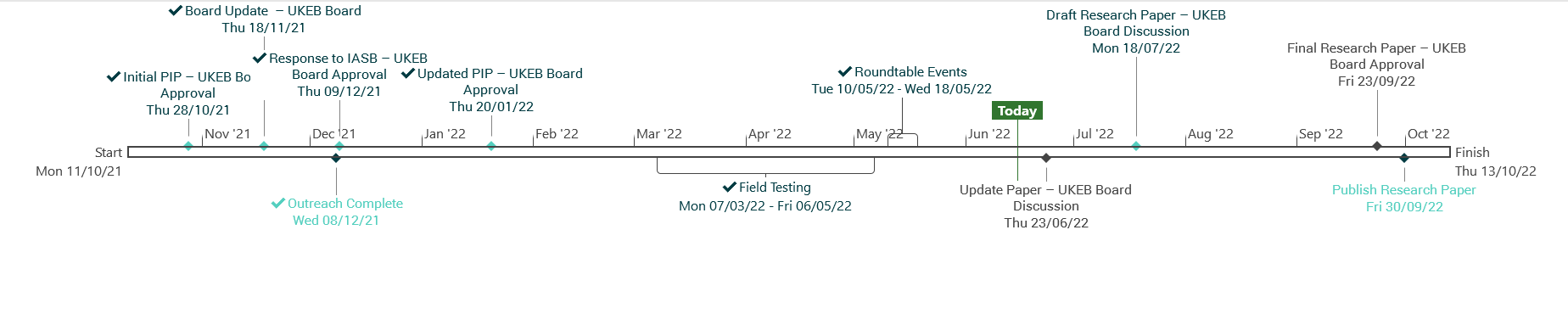
28We are proposing to update the research timeline from that approved by the Board at the April 2022 Board Meeting. We are now proposing bringing the draft research paper to the Board for approval in July 2022 rather than in June 2022. This is to increase our opportunity to engage with users of financial statements during the project and to reflect the IASB's project timeline which indicates that the IASB will vote on the subsequent measurement of goodwill in Q4 2022.
Questions for the Board
29Does the Board approve the proposed updated timeline?
30Does the Board have any comments on the initial findings from field-testing?
Appendix 2 Project initiation plan: Subsequent measurement of goodwill
| Project Type | Research |
|---|---|
| Project Scope | Limited scope |
Overview
1The IASB has begun redeliberating the preliminary views in its DP 2020/1 Business Combinations: Disclosures, Goodwill and Impairment (the Discussion Paper). In the Discussion Paper, the IASB supported retaining the impairment-only model for the subsequent measurement of goodwill. Responses to this preliminary view were mixed: some respondents supported maintaining the impairment-only model whereas others recommended the reintroduction of amortisation. The UKEB Secretariat's response advocated a hybrid model for the subsequent measurement of goodwill. In the hybrid model, an annual amortisation charge is supported by impairment testing.
2The proposed project responds to and expands on a request from IASB staff. The IASB discussed its plan for redeliberations on this project at its September 2021 meeting. It agreed that further work would be prioritised to support redeliberations on goodwill measurement. To inform the Board's redeliberations on this topic, IASB staff identified two specific areas of analysis that they intended to carry out with support from national standard setters. These areas were:
- How the useful life of goodwill is determined for amortisation purposes under national GAAP; and
- The potential impacts of transitioning to an amortisation model.
3We have identified two further areas for analysis that we anticipate will be useful to the IASB in its ongoing redeliberations. These areas are:
- How a hybrid model can provide information that is useful for users.
- Cost implications of a hybrid model.
4We recommend field-testing potential transitional arrangements to the hybrid model from the current IFRS impairment-only model. We have discussed the proposed field-testing with IASB staff. IASB staff confirmed that evidence from field-testing would be of interest to them, and that our proposed timeline would allow for that evidence to be considered during the IASB's redeliberations. The IASB has recently updated its plans so that it will decide on the project's direction in H24 2022.
5We intend to publicly promote the field-testing and will seek input from users, preparers, auditors, and academics.
6The proposed field-testing of transitional arrangements will explore:
- The relative merits of prospective and retrospective application;
- The advantages and disadvantages of full retrospective application;
- The factors that management would consider in determining the useful life of goodwill for amortisation purposes if retrospective application were required and how those factors might vary for different acquisitions and components of goodwill;
- Whether any additional disclosures relevant to those factors might also be useful information for users of accounts and if so, what those additional disclosures would be;
- Whether assumptions applied in determining the useful life of goodwill for amortisation purposes would be consistent with assumptions about the allocation of goodwill to cash-generating units for impairment testing purposes, and;
- The cost and resource implications of a potential transition.
7As part of the proposed field-testing, we will also seek UK stakeholder views and evidence on:
- The IASB's proposed disclosures on business combinations.5
- The frequency of trade and assets acquisitions with material goodwill and the implications of these goodwill balances for distributable profits.
8The proposed project contributes to the influencing activities delegated to the UKEB in SI/2019/685(5)(b).6
Project objectives, scope, and output
9Undertaking the project is relevant for the UKEB and its stakeholders because:
- Much of the current debate on the subsequent measurement of goodwill assumes that an amortisation model would result in a loss of useful information by imposing an arbitrary period for the amortisation of goodwill. Field-testing retrospective application of transitional arrangements will provide an opportunity to explore whether a hybrid model, which combines amortisation with regular impairment tests, could provide a more faithful representation and continue to provide information that is relevant to users.
- Goodwill represented approximately 15% of total assets for UK FTSE 350 and AIM entities in 2020; and
- M&A activity by IFRS reporters in the UK is expected to increase in the immediate and medium term.7
10We anticipate that undertaking the project will deliver the following benefits for the UKEB:
- Timely engagement with the IASB: the project provides an opportunity to support the IASB in a timely manner.
- Profile building: the project provides an opportunity to contribute new, UK-specific evidence to the ongoing international debate on goodwill.
- Stakeholder engagement: the outreach on this project will contribute to building relationships with UK preparers, users, auditors, and regulators.
11The IASB's objective in undertaking this project is to assemble relevant evidence to underpin their redeliberations on subsequent measurement of goodwill.
12The UKEB's objectives in undertaking this project are to:
- Build the UKEB's reputation as a significant and positive participant in the development of global accounting standards; and
- Demonstrate the UKEB guiding principle of thought-leadership by anticipating IASB's information needs and contributing UK-specific evidence to the international debate on goodwill; and
- Demonstrate the UKEB guiding principle of accountability through outreach to UK stakeholders.
13The intended outputs of the project are:
- A comprehensive analysis in response to the IASB's request; and
- A research paper presenting project findings and conclusions, to be published on the UKEB website.
14Once the research scoped in this PIP is complete, the UKEB may wish to consider further research or developing the research paper in formats suitable for wider publication. We intend to consult with the Board on any additional research or development of the research paper for wider publication before commencing any work outside the scope of this PIP.
15The UKEB will propose presenting the research paper at future international meetings with other global standard setters, including the July 2022 Accounting Standards Advisory Forum (ASAF) meeting and September 2022 International Forum of Accounting Standard Setters (IFASS) meeting.
Approach
16The project approach will comprise desk-based research and stakeholder outreach. The goodwill research project team will be alert to opportunities to co-ordinate with the UKEB's intangibles project team, to ensure efficiency and consistency between the two research projects where appropriate.
17The table in appendix A outlines the proposed questions, initial findings and proposed further work. Secretariat will provide updates to the Board as necessary throughout the project.
Key milestones and proposed timeline
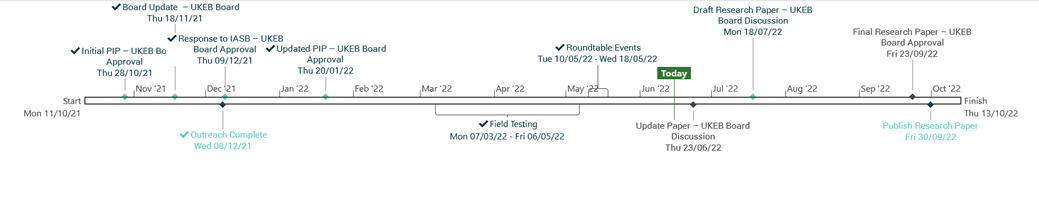
18The proposed high-level project timeline is as follows:
| Month | Activity / Milestone |
|---|---|
| October 2021 | Board meeting: approval of initial PIP |
| October – November 2021 | Desk-based research |
| November 2021 | Outreach activities |
| December 2021 | Board meeting: approve analysis for submission to IASB |
| December 2021 | Share analysis with IASB and publish on UKEB website |
| January 2022 | Board meeting: approval of updated PIP |
| February 2022 | Develop field-testing materials |
| March – April 2022 | Field-testing with stakeholders |
| June 2022 | Board meeting: discuss initial findings from field-test submissions and approve updated PIP |
| July |
Board meeting: approve |
| September 2022 | Board meeting: approve final research paper for publication on UKEB website |
The timeline is shown below:
Assumptions
19We have made the following assumptions in developing this project initiation plan:
- Planned further research will result in sufficient depth and breadth of analysis (planned further research is shown in appendix A).
- There are no significant changes to project scope.
- The resource allocated to the project is 50% of a project director's time and 40% of a project manager's time for the duration of the project. These resources are available and included in the current UKEB budget.
- IASB timelines do not change.
- We will not prepare a feedback statement or a statement of compliance with due process for the project, since neither are required by the current draft of the UKEB Due Process Handbook and would not be the best use of staff resource.
Next Steps
20Subject to Board approval, we will commence the research and analysis activities outlined in Appendix 1.
21Subject to Board approval, we will present the research paper to the UKEB May 2022 Board meeting.
Footnotes
Footnotes
-
Initial outreach with investors identified the following potential benefits from the hybrid model: a) Insight into the strategic rationale for acquisitions through improved disclosures on the components of goodwill and assumptions underpinning the useful life of goodwill b) Enhanced management accountability through an analysis of gross goodwill by acquisition. ↩
-
Initial outreach with investors identified the following concerns about a potential hybrid model: a) The need for sufficient disclosure to be able to derive an operating profit figure before amortisation, needed for the calculation of return on invested capital b) Loss of disclosures underpinning the determination of recoverable amount under the impairment-only model. ↩
-
See UKEB response to IASB's research request, December 2021 ↩
-
IASB's project timeline was updated on 17 December 2022. It reflects IASB's current project plan to decide on the project's direction in H2 2022. Previously IASB's intention was to vote on the proposals in the DP in Q2 2022. ↩
-
The DP proposes disclosure of anticipated synergies, strategic rationale for the business combination, and the metrics used to monitor the business combination. IASB staff have developed illustrative examples of these disclosures which we intend to incorporate in our proposed field-testing. ↩
-
The International Accounting Standards and European Public Limited-Liability Company (Amendment etc.) (EU Exit) Regulations 2019: https://www.legislation.gov.uk/uksi/2019/685/made ↩
-
Source – Lexis Nexis market tracker trend report: Trends in UK Public M&A in 2020. ↩