4.0 IFRS 17 Update on Consultation (including RITC)
UK ENDORSEMENT BOARD 20 JANUARY 2022 AGENDA PAPER 4

Executive Summary
| Category | Details |
|---|---|
| Project Type | Endorsement |
| Project Scope | Significant |
| Purpose of the paper | This paper presents an update on the public consultation on the [Draft] Endorsement Criteria Assessment (DECA) for IFRS 17. In addition, the paper provides further information on ongoing discussions relating to the application of IFRS 17 to Reinsurance to close transactions (RITC) in the Lloyd's market. |
| Summary of the Issue | The public consultation on the IFRS 17 DECA is ongoing (comment deadline: 3 February). The issue in respect of CSM allocation for annuities is now being considered by the IFRS Interpretations Committee. Any developments will be reported at relevant Board meetings. Discussion with stakeholders and analysis of issues arising from the application of IFRS 17 to Lloyd's market RITC transactions are ongoing and are summarised in this paper. |
| Next steps | a more detailed update on stakeholder responses to the consultation on the IFRS 17 DECA will be brought to the Board's February 2022 meeting. This will include a tentative assessment of issues arising in respect of RITC accounting. |
| Decisions for the Board | No decisions are required at this meeting. |
| Recommendation | N/A |
| Appendices | Appendix 1 – illustrative examples of expected accounting for RITC transactions |
General
1The IFRS 17 DECA was issued for public consultation on 11 November 2021. We have promoted awareness of the consultation and encouraged stakeholders to respond through regular news alerts, speaking engagements (including to industry groups and professional bodies), ongoing outreach to UK stakeholders and by advertising through the usual channels.
2Three formal responses have been received so far. We expect to receive the great majority of stakeholder responses towards the end of the consultation period. Two responses to date were from users of accounts and overall were positive about the adoption of IFRS 17 for use in the UK. The third response was from an accounting firm and is supportive of timely adoption of the standard without modification. Some stakeholders have informed us that their responses are in preparation. The 12-week public consultation period ends on 3 February 2022.
3The narrow scope amendment to IFRS 17 Initial Application of IFRS 17 and IFRS 9 – Comparative Information was issued in December 2021. Our limited targeted outreach has given no indication that the finalisation of the amendment is likely to give rise to significant endorsement issues or that the proposed classification overlay will be widely used in the UK. The Invitation to Comment on the IFRS 17 DECA includes a specific question on the amendment.
CSM allocation for annuities
4As the Board is aware, the UK insurance industry has requested advice from the IASB on the interpretation of IFRS 17's requirements with respect to the service provided by a life contingent annuity and the recognition of that service through the release of the contractual service margin (CSM).
5The IASB has decided that the issue should be considered by the IFRS Interpretations Committee and the submission is listed on the IASB's website as an Interpretations Committee pipeline request.1 There is a possibility that information on the issue may first be presented to the Interpretations Committee at its meeting on 1 February, with discussions and analysis to follow at its next meeting on 15/16 March. Papers for these meetings are not yet available.
6The UKEB's March 2022 meeting is scheduled for 18 March, so it is likely that some indication of the Interpretations Committee's thinking on this issue will be available by the time the Board considers implications for the IFRS 17 endorsement decision of stakeholder feedback on the DECA.
Questions for the Board
7Does the Board have any questions on the updates above?
Reinsurance to close transactions at Lloyd's
8As the Board is aware, further work is also being carried out relating to reinsurance to close (RITC) transactions in the Lloyd's market. Some stakeholders have concerns about the complexity and hence cost of the required accounting under IFRS 17 and about the potential impact on the competitiveness of the Lloyd's market.
9The UKEB Secretariat established a working group, separate from the Insurance TAG, comprising auditors, advisers and a user of accounts as well as preparers with expertise in these very specialist contracts. The aim is for this group to provide us with a wider perspective on the issue. A discussion was held with the working group on 6 January 2022 and a summary of the key matters covered is included below.
Summary of RITC Working Group Discussion
Background
10Insurance business at Lloyd's is written through syndicates. The nature of underwriting at Lloyd's is that each syndicate member is responsible for its share of each contract underwritten based on the proportion of capital each member has contributed to the syndicate. All the syndicate's assets, liabilities, income and expenses are shared in proportion to the capital contributed.
11In its accounts, a corporate member aggregates its shares of the assets and liabilities of each year of account in which it participates.
12The Lloyd's year of account mechanism means that Lloyd's members provide capital for one underwriting year of account at a time. Having underwritten one year of account, each member can decide whether to continue underwriting for the next year of account. Each individual year of account is a separate annual venture.
13Lloyd's members cannot take their profit for a year of account at the end of that year. Instead, they must wait a period, typically three years from the beginning of the year of account, before they receive a profit, or are asked to make good losses, from that year of account.
14RITC is a mechanism to 'transfer' insurance liabilities from one year of account to the next year of account, typically at the end of three calendar years. It may be viewed as the reinsurance of an entire year of account, effected by the payment of a reinsurance premium by the members of the 'closing' year (the ceding members) to the members of the 'accepting' year (the reinsuring members). This occurs even if members wish to maintain their participation in the syndicate. Following an RITC transaction, a ceding member is allowed to withdraw its capital in respect of the closing year of account.
15The RITC typically reinsures the liabilities into the next year of account of the same syndicate, though it could also be to a different syndicate. The level of participation of a member in a syndicate may vary from one year of account to the next, and members may enter or exit a syndicate.
Current accounting under IFRS 4
16Under IFRS 4 (and under UK GAAP), RITC transactions have generally been treated as transferring obligations under insurance contracts from the members participating in one year-of-account to those participating in a later year of account. The ceding members of the syndicate derecognise the relevant insurance liabilities and the receiving (reinsuring) members recognise the liabilities on the same basis.
17Under current accounting a corporate member therefore derecognises its interest in the assets and liabilities of the earlier year of account and recognises its interest in the later year of account at its new level of participation, whether that is the same, higher or lower. In practice, this may be achieved by simply adjusting the relevant balances, as for a change in estimates. See illustrative example 1 in the Appendix.
Principal issues arising from application of IFRS 17
18IFRS 17 does not explicitly address the accounting for RITC transactions. However, we understand that application of IFRS 17's requirements is expected to result in the accounting treatment reflected in the illustrative examples set out in the Appendix.2
Derecognition?
19The fundamental question that drives the accounting outcomes is whether an RITC transaction leads to the derecognition of a corporate member's interest in the earlier year of account. This question is relevant whether a corporate member maintains, increases or decreases its participation in a syndicate, or exits the syndicate completely.
20IFRS 17 paragraph 74 states:
“An entity shall derecognise an insurance contract when, and only when:
a) it is extinguished, ie when the obligation specified in the insurance contract expires or is discharged or cancelled; or
b) any of the conditions in paragraph 72 are met.”
21Paragraph 72 of IFRS 17 sets out the conditions under which the modification of a contract leads to derecognition of the contract and recognition of the modified contract as a new contract. We understand there is agreement that none of those conditions are relevant in the case of an RITC contract. Other contract modifications are treated as changes in estimates of cash flows (IFRS 17 paragraph 73).
22The working group discussion indicated that there are different views on the interpretation of IFRS 17 paragraph 74 (e.g. whether the original obligation might be viewed as 'discharged' by an RITC contract) and on whether an RITC transaction represents a modification of an insurance contract. The unusual way in which insurance contracts at Lloyd's are structured and operate, and the unique characteristics of RITC contracts, add complexity to the interpretation. Factors include:
- The contracting parties to the underlying insurance contracts: we understand that members are not necessarily signatories to the insurance contract and that the policyholder is generally unaware of their identity. The working group noted that the contract bears the name of Lloyd's and is entered into by the syndicate's managing agent. However, on the other hand it is understood that the syndicate does not have legal personality.
- Parties to the RITC contract. The RITC contract is between syndicate members (some or all of whom could be the same parties) and does not involve policyholders or change any terms in the underlying insurance contract.
- Role of Lloyd's Byelaws. In addition to the terms of the insurance and RITC contracts, it may be necessary to take into account the Lloyd's Byelaws which govern the operation of both contracts.3
23We understand, however, that the consensus of the ICAEW Insurance Committee4 was that an RITC contract does function as a type of reinsurance contract and that under IFRS 17 the criteria for derecognising the corporate member's interest in the earlier year of account (the original insurance contract liabilities) are unlikely to be met. Similarly, it seems unlikely that an RITC contract represents the modification of the terms of an insurance contract.
Concerns with expected accounting under IFRS 17
24On the basis of the consensus noted in the previous paragraph, a corporate member would be expected to continue recognising the insurance liabilities from the earlier year of account even after entering into an RITC contract. This means that its interest in the earlier and later years of account would need to be recognised on a 'gross', consolidated basis.
Complexity and cost
25Whereas many corporate members will apply only the Premium Allocation Approach (PAA) to their original insurance contract liabilities,5 in many cases any reinsurance liability (under an RITC contract) will be a liability for remaining coverage accounted for under the General Measurement Model (GMM). Additional accounting systems will need to be established and two measurement bases will be applied to the same group of contracts.
26In cases where the original insurance contract liabilities are accounted for under the GMM, two different CSMs and potentially also two different risk adjustments will need to be recognised for the same group of contracts.
27In each of these circumstances, complexity would be compounded if there were a second RITC transaction in a subsequent year for the same contracts.
28The working group noted that reinsurance assets recognised under IFRS 17 would not necessarily precisely match the liabilities (including due to differing profit or loss recognition profiles). The group also noted that a fully retrospective approach to transition would not be possible in many cases since members (and managing agents) would not always have the necessary records for the liabilities derecognised under IFRS 4.
29The working group confirmed that additional complexity and cost would arise, both under scenarios in which a corporate member increased its participation in a syndicate and under scenarios in which its participation declined or ceased. In particular, if a corporate member exited a syndicate completely, it would still need to maintain its accounting for its participation in the earlier year of account (liabilities offset by a reinsurance asset – see illustrative example 5 in the Appendix). Such accounting would be required until the liability was extinguished, which in some cases could be a number of years.
Form over substance?
30Some stakeholders are concerned that the expected accounting under IFRS 17 does not fairly reflect the economic substance of the transactions.
31Those who share this concern consider that in substance the RITC has transferred the liabilities to the reinsuring members and that the RITC is a change in a co-insurance arrangement between syndicate members. They assert that the economic substance is that the member's participation in the original insurance liabilities has changed and would best be represented as a change in expected cash flows (similar to a modification under IFRS 17 paragraph 73).
32In this context the working group noted the Lloyd's ‘chain of security' which means the effect of an RITC is different from that of other reinsurance contracts. If reinsuring members cannot meet their financial obligations arising from acceptance of liabilities under the RITC, Lloyd's Council may use its discretion to apply the Lloyd's Central Fund to settle the liabilities. Only if the Central Fund were exhausted or the Council decided against applying it would the liability fall on the ceding members. We understand this has never occurred during the existence of Lloyd's (over 300 years). Some stakeholders therefore consider that, for all practical purposes, an RITC has a similar effect to a transfer of liabilities from one group of members to another.
33An alternative view is that the expected accounting under IFRS 17 fairly reflects the economics. For example, where a member's participation increases, the accounting (example 3 in the Appendix) reflects the fact that the additional portion is a reinsurance liability by nature, that it was 'acquired' from third parties, and that the member incurred it at a different time and potentially at a different price from the original liability. Where relevant, the application of a different accounting model (i.e. GMM rather than PAA) would reflect the fact that the uncertain obligation relates to the settlement of incurred claims rather than to whether a claim would arise in the first place. The accounting is therefore consistent with that for transfers of insurance contracts (B93 – B95D).
34Similarly, under this alternative view, in a case where a member's participation has declined (example 4 in the Appendix), the expected accounting appropriately reflects the fact that the member retains the ultimate legal liability for the underlying insurance contracts but has received (and paid for) reinsurance coverage from third parties.
Wider impact
35Our understanding is that the key concerns are:
- Market efficiency. RITC is considered an effective method of transferring liabilities and corresponding assets and ensures low barriers to market entry and exit. If exiting the market were made significantly more difficult, this could damage the attractiveness of the Lloyd's market.
- Competition: IFRS reporters could be at a disadvantage to corporate members reporting using a different GAAP that permits less complex accounting.
- Availability of data. the necessary data to enable ceding members to continue to account for the original insurance contract liabilities would not be available to members exiting the syndicate entirely given current Lloyd's market practices. Data required for the ongoing accounting is provided only to the reinsuring members.
36We understand that alternatives to the current RITC mechanism would include novation of liabilities or Part VII transfers but that both alternatives would require considerably more time and resources to achieve.
37The working group confirmed that issues concerning the lack of data arose only when a member exited a syndicate entirely.
38Preliminary information indicates that at 31 December 2020 there were some five or six third party RITC transactions, where members ‘transfer' their involvement to an entirely different syndicate, involving gross reserves of approximately £1.8bn. We understand that there are at least five syndicates currently dedicated to acquiring legacy/run-off business through RITC transactions.
39Based on the working group discussion, we understand that those third party RITC transactions as at 31 December 2020 did not involve current UK IFRS reporters. The group noted that accounting issues related to increases in participation were of more immediate relevance to UK IFRS reporters. It was acknowledged that the accounting issues arising from the application of IFRS 17 to RITC contracts were probably not currently material to UK IFRS reporters, considering the activity in recent years. However, such issues could potentially become more significant in future.
Questions for the Board
40Does the Board have any comments or questions on the above summary of the principal matters arising in respect of the accounting for RITC transactions under IFRS 17?
Next steps
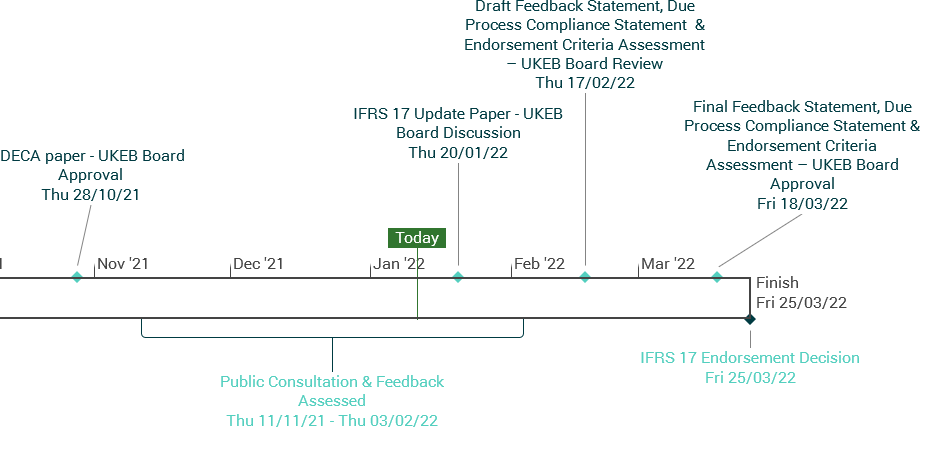
41The remaining IFRS 17 project plan can be summarised as set out below. The timing of project completion is of course subject to the extent and nature of stakeholder feedback received on the DECA.
Appendix
RITC accounting: simplified illustrative examples
Base scenario
- The 2023 year of account is reinsured by means of an RITC contract into the 2024 year of account (at the end of 2025)
- Syndicate policyholder liabilities of £100,000 comprise: £80,000 liability for incurred claims (LIC) and £20,000 unearned premium (LRC)
- £100,000 of assets (cash) are transferred between the years of account to support the liabilities
Current accounting
Illustrative example 1 - level of participation increases
The Corporate Member participates 50% in the 2023 year of account and 50% in the 2024 year of account
| PRE 2023 | POST-RITC (Change) | POST-RITC (2024) | |
|---|---|---|---|
| Cash | 50,000 | 20,000 | 70,000 |
| Reinsurance asset | |||
| LIC | -40,000 | -16,000 | -56,000 |
| LRC | -10,000 | -4,000 | -14,000 |
| Reinsurance LRC |
Expected IFRS 17 accounting
Illustrative example 2 – level of participation remains unchanged
The Corporate Member participates 50% in the 2023 year of account and 50% in the 2024 year of account
| PRE 2023 | POST-RITC 2023 | POST-RITC 2024 | POST-RITC Elim. | Total | |
|---|---|---|---|---|---|
| Cash | 50,000 | 50,000 | 50,000 | ||
| Reinsurance asset | 50,000 | -50,000 | - | ||
| LIC | -40,000 | -40,000 | -40,000 | ||
| LRC | -10,000 | -10,000 | -10,000 | ||
| Reinsurance LRC | -50,000 | 50,000 |
Illustrative example 3 increase in participation
The Corporate Member participates 50% in the 2023 year of account and 70% in the 2024 year of account
| PRE 2023 | POST-RITC 2023 | POST-RITC 2024 | POST-RITC Elim. | Total | |
|---|---|---|---|---|---|
| Cash | 50,000 | 70,000 | 70,000 | ||
| Reinsurance asset | 50,000 | -50,000 | - | ||
| LIC | -40,000 | -40,000 | -40,000 | ||
| LRC | -10,000 | -10,000 | -10,000 | ||
| Reinsurance LRC | -70,000 | 50,000 | -20,000 |
Illustrative example 4 decrease in participation
The Corporate Member participates 50% in the 2023 year of account and 30% in the 2024 year of account
| PRE 2023 | POST-RITC 2023 | POST-RITC 2024 | POST-RITC Elim. | Total | |
|---|---|---|---|---|---|
| Cash | 50,000 | 30,000 | 30,000 | ||
| Reinsurance asset | 50,000 | -30,000 | 20,000 | ||
| LIC | -40,000 | -40,000 | -40,000 | ||
| LRC | -10,000 | -10,000 | -10,000 | ||
| Reinsurance LRC | -30,000 | 30,000 |
Illustrative example 5 decrease in participation to nil
The Corporate Member participates 50% in the 2023 year of account and 0% in the 2024 year of account
| PRE 2023 | POST-RITC 2023 | POST-RITC 2024 | POST-RITC Elim. | Total | |
|---|---|---|---|---|---|
| Cash | 50,000 | 50,000 | |||
| Reinsurance asset | 50,000 | - | |||
| LIC | -40,000 | -40,000 | -40,000 | ||
| LRC | -10,000 | -10,000 | -10,000 | ||
| Reinsurance LRC |
Footnotes
-
https://www.ifrs.org/projects/pipeline-projects/#interpretations-committee-pipeline. ↩
-
The illustrative examples are based on one provided in an ICAEW Insurance Committee paper. We have added scenarios in which the corporate member's participation in the syndicate is stable or declines rather than increases. ↩
-
In this context, the working group also considered the potential effect of IFRS 17 paragraph 2, which states that an entity "shall consider its substantive rights and obligations, whether they arise from a contract, law or regulation..." and that “contracts can be written, oral or implied by an entity's customary business practices." Paragraph 2 goes on to say that “an entity shall disregard terms that have no commercial substance (ie no discernible effect on the economics of the contract).” ↩
-
The ICAEW Insurance Committee is an industry technical committee run by the Financial Services Faculty of the ICAEW. It has no power to develop accounting standards guidance, interpretations or opinions ↩
-
Due to the fact that their contracts are non-life contracts with coverage periods of one year or less ↩
-
Although our immediate interest is with the impact on UK insurance entities directly affected by the UKEB's IFRS 17 adoption decision, the working group noted that overseas groups operating at Lloyd's and reporting using IFRS (e.g. in Canada and Australia) would also have to address accounting issues arising from the application of IFRS 17 to business at Lloyd's. ↩
-
The illustrative examples are based on one provided in an ICAEW Insurance Committee paper (example 3 below) ↩