8.0 Intangible Assets – Approve PIP
Executive Summary
| Project Type | Thought Leadership |
|---|---|
| Project Scope | Significant |
Purpose of the Paper
This paper presents a draft Project Initiation Plan (PIP) in respect of the Intangible Asset pro-active research project.
Summary of the Issue
While the increasing importance of intangible assets to the modern economy is widely acknowledged, there are growing concerns about shortfalls in their accounting and reporting under IFRS Accounting Standards. Based on feedback to the IASB's Third Agenda Consultation we expect intangible assets to form a key part of its agenda for the next five-year period.
A pro-active thought leadership project on intangible assets will enable the UKEB to fulfil its responsibility to proactively participate in the development of high-quality accounting standards by leading the UK debate on accounting and reporting of intangible assets. This research will also contribute to the international debate on a timely basis.
Decisions for the Board
The Board is asked to approve the draft PIP.
Recommendation
We recommend the Board approves the draft PIP.
Appendices
Appendix 1 Draft Project initiation Plan
| Project Type | Thought Leadership |
|---|---|
| Project Scope | Significant |
Overview
1The UKEB delegated functions include responsibility for “participating in and contributing to the development of a single set of international accounting standards.” Undertaking pro-active thought leadership activities is key to the UKEB's ability to effectively deliver this statutory function.
2The UKEB's Terms of Reference (ToR) further explain that with regard to thought leadership, the UKEB shall:
- Lead the UK debate on international accounting standards and reporting.
- Represent UK views in international fora with the aim of influencing debate.
- Engage with accounting and reporting and endorsement and adoption bodies in other jurisdictions, in order to improve influence and understand best practice.
- Proactively participate in the development of new global accounting standards, for example by undertaking research.
3We believe that a project on intangible assets, as described below, clearly supports the UKEB meeting these responsibilities.
4The increasing importance of intangible assets to the modern economy is ubiquitously acknowledged, as demonstrated by the numerous academic papers1 and books2 written on this topic. As noted by CPA Ontario “Today, intangible assets are recognized as the key source of innovation and growth, an economic golden goose”3.
5At the same time there is significant discussion about the shortfalls of IFRS Standards4 in relation to accounting for intangible assets. EFRAG published a comprehensive report, outlining a range of concerns with current accounting for intangible assets and possible approaches to improving their reporting.5
6Concerns about the accounting for and reporting of intangible assets are not only confined to academic discussions and national standard setters. Steve Cooper, an independent analyst, co-author of The Footnotes Analyst blog, and former IASB Board Member, has stated that, “the current inconsistent and limited recognition of intangible assets causes analytical challenges for investors... We think that investors would greatly benefit from improvements to both the narrative reporting and financial statement data regarding intangibles."6
7These concerns have been echoed in surveys of users. For example:
- In 2019 the FRC published a consultation “Business Reporting of Intangibles: Realistic Proposals”7. They noted when reporting the feedback received from UK investors that they “were unanimous in their support for improving the quality of reporting on intangibles" 8
- Research currently being funded by ICAS has noted that 93% of users surveyed thought that "financial reporting is lacking adequate information on intangible assets”, though they also note that this view was only shared by 61% of preparers surveyed.9
- A worldwide survey of 170 senior investment decision makers commissioned by Columbia Threadneedle Investments concluded that, “There is agreement that analysis of intangibles provides a competitive advantage to investors, and recognition that intangible research is increasingly important in analytical work. However, while investors find information about intangibles readily available, they believe that it is often unreliable, incomplete or inaccurate.”10
8The IASB has acknowledged these concerns about intangible assets. In one of his first public statements the new chair of the IASB, Dr Andreas Barckow, stated that “the rise of self-generated intellectual property and its non-addressal in the accounts” was one of the biggest challenges and opportunities facing the IASB.11
9Staff papers presented to the IASB summarising the feedback it received on its Third Agenda Consultation12 indicated that most respondents rated intangible assets as a high priority area.13 Respondents believed any review should:
- modernise IAS 38 Intangible Assets, to better reflect the ever-increasing importance of intangible assets in today's business models, particularly for unrecognised internally generated assets;
- address new types of intangible assets, which were not envisaged when IAS 38 was developed (such as cryptocurrencies and emission rights) to ensure it results in useful information to users of financial statements; and
- improve comparability between companies that grow organically and those that grow through acquisitions.
10Based on that feedback we expect intangible assets to form a key part of the IASB's agenda for the next five-year period.
11A pro-active thought leadership project on intangible assets will enable the UKEB to fulfil its responsibility to proactively participate in the development of high-quality accounting standards by leading the UK debate on accounting and reporting of intangible assets as well as contributing to and actively participating in the international debate on a timely basis.
Objective of the project
12Given the significance of intangible assets to the UK and global economies in the twenty-first century, and the expectation that a project on accounting for such assets will form a key part of the IASB's agenda in the future, it is important that the UKEB pro-actively contributes to this important area of standard development.
13"Intangible assets" encompasses a wide range of possible topics and avenues for research. The UKEB believes that it is well placed to focus on elements of investor needs when it comes to accounting and reporting of intangible assets. This will act as a useful starting point for, and input into, the accounting solutions to be devised by the IASB.
14The question to be addressed by the proposed research is:
How could the accounting for, and reporting of, Intangible Assets be improved to provide investors with more useful general purpose financial statements to assist them to make better informed decisions?
15Key elements of the research question proposed are:
- Accounting and reporting14: The research will be focussed on accounting and reporting in accordance with IFRS Accounting Standards, and the annual financial statements. Specifically, the research will look at classification, recognition, measurement, and disclosure of intangible assets. This does not necessarily mean that the current approach of the IFRS Accounting Standards should constrain possible solutions. It may be that new or expanded standards need to be developed to capture useful information.
- Intangible Assets: This term is a placeholder for a broad range of non-physical assets that are not within the scope of IFRS 9: Financial Instruments, and is not necessarily intended to be the same as defined in IAS 38: Intangible Assets. Part of the research would seek to identify what investors consider the most relevant intangible assets, and whether current definitions adequately capture the extent and nature of these assets.
- Investors: The Conceptual Framework for Financial Reporting15 identifies the primary users of financial reports as existing and potential investors, lenders and other creditors that cannot require reporting entities to provide information directly to them. We believe that a focus on investors who rely on General Purpose Financial Statements (GPFS) will provide useful information while helping limit the extent of research that will need to be undertaken. These users make key decisions that involve buying, selling or holding equity instruments; or exercising rights to vote on, or otherwise influence, management's actions that affect the use of the entity's economic resources.
16One objective of the research will be to help investors engage with new ways of thinking about the issue of accounting for and reporting on intangible assets. We therefore also intend to engage with other stakeholders, such as academics and preparers (especially in sectors that have intangible assets identified as particularly relevant by investors) to develop possible alternative approaches that may not yet have been considered by investors which could meet their information needs. This would allow us to facilitate discussions between key stakeholders to develop solutions.
17The research would be based on a bottom-up or inductive approach. Building from investors' needs and observations of practice to develop proposals. This can be contrasted with the top-down or deductive approach that would start with the conceptual framework and develop solutions rooted in accounting theory.
18This approach will allow us to contribute to and reflect on the work being done by others in this area, such as EFRAG and the AASB. By building on our links with investors we believe we will be able to provide an important perspective on any solutions proposed by others.
19It will also build on previous work in the UK by the FRC, for example, the FRC's 2019 consultation "Business Reporting of Intangibles: Realistic Proposals”.
Key planning assumptions, constraints and timeline
Project timeline and resource capacity
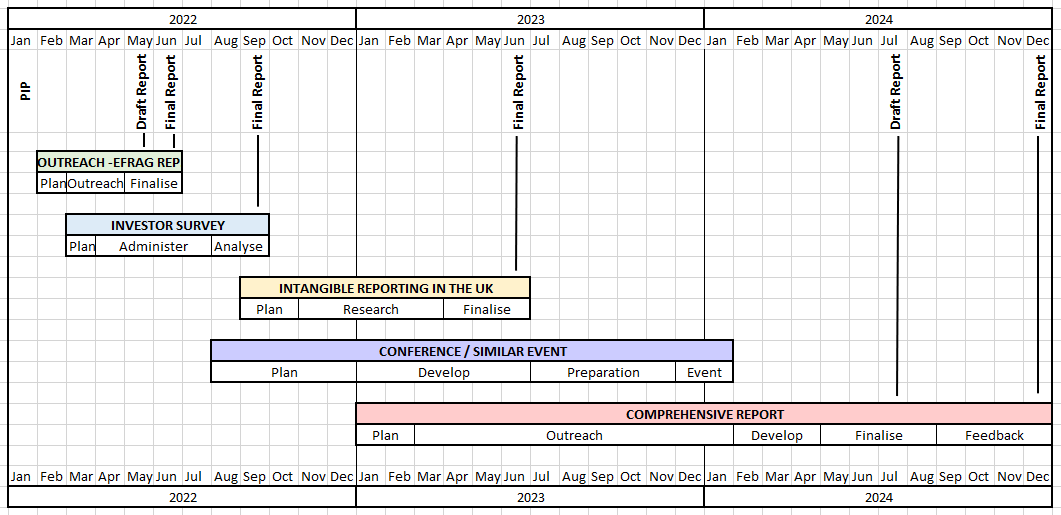
20As noted below this project is expected to last at least 3 years, with a number of milestones along the way, including at least 5 major outputs. This timeline would fit into the IASB's expected review of intangible assets, that is likely to be a long-term project commencing later in 2023. Therefore, we believe that a comprehensive report setting out the findings from the UKEB research project in late 2024 or early 2025 would be well timed to support IASB activities in this area.
21It is expected that the project would require input from the following technical staff:
- 40-50% of one accounting specialist project director on a consistent basis;
- up to 40% of a member of the economics team at various stages to support specific outputs; and
- 25% of a project manager on a consistent basis to support the project.
22Production of regular outputs is important to retaining interest and momentum in the project over the three-year period, and is factored into the resource allocation. For example, one early output proposed is a paper addressing questions asked in the EFRAG's Discussion Paper: Better Reporting on Intangibles, which has a deadline of 30 June 2022. This will require significant activity in the first half of 2022.
23It is also important to acknowledge that additional research opportunities and outputs could be identified or emerge while the project is underway. Any additional proposed research would be presented to the Board as appropriate.
Assumptions
24Once established, the UKEB's user and academic advisory groups will form a key part of any outreach. We may be able to utilise the IASB's Investor contacts, along with the knowledge of our liaison IASB Board Member.
25We do not plan on setting up an ad hoc external group at this point in time. However, a sub-group of UKEB Board members to provide ongoing advice would be useful. We believe a group of three or four Board members, including an investor and academic representative would be appropriate. They would be regularly consulted and appraised of progress on the project and would provide an important link back to the Board.
26We will look to academics to support the research, in particular with identifying alternative approaches to addressing the accounting for intangible assets. As noted, a future academic advisory group will play a key role in supporting engagement with academics. We would also look to bring academics and users together as part of some of the outputs discussed below and may consider commissioning empirical research.
27It is expected that a number of the activities to be undertaken as part of this project will have synergistic opportunities to collaborate with and contribute to other UKEB projects. For example, there is overlap with the Goodwill and Impairment research currently being undertaken. We will actively look for ways to incorporate cross-sectional thinking and help ensure maximum impact for this thought leadership project.
28We also see this project as an opportunity to engage with other NSS and international stakeholders (including the IASB). We will actively look to collaborate with others to enhance the research activities being undertaken and increase the impact of the work being done. Some of these opportunities are noted below, others will emerge over time.
Risks
29Traditionally, it has been difficult to engage with investors. Though provision of information to investors is the focus of accounting information, the time scales involved in development of accounting standards makes it difficult to engage with this key stakeholder group as they are more focussed on what they are seeing today in financial statements.
30Maintaining the momentum, consistency and quality of the project over a long period of time is difficult at best. We intend to mitigate this by ensuring that a lead project director is allocated to the project. This individual will be responsible for coordinating the ongoing involvement of other members of the team at appropriate junctures.
31The IASB's specific plans regarding the scope and timing of the intangibles project may not be known for some time. We are planning on the assumption we will be able to contribute to the early stages of the project. The UKEB project timelines and milestones will need to remain flexible in order to respond to developments at the IASB to ensure the UKEB outputs are timely and have maximum impact on the activities of the IASB.
Outputs
32The research project is currently framed around 5 major outputs. Subsequent outputs are expected to build on preceding ones. Additional or alternative outputs, for example to respond to IASB decisions, will also be incorporated in the future.
Major Output 1 - Report on UKEB outreach on EFRAG research paper (HI 2022)
33In H1 2022 we will conduct outreach with UK stakeholders based on questions asked in the EFRAG research paper – Better Information on Intangibles. See summary of this paper in Annex A below.
34We will seek to work with EFRAG on outreach with a range of stakeholders, including investors. For example, we could consider joint roundtables on specific elements of the EFRAG report.
35We expect to publish a draft report on the outreach with an invitation to comment in May 2022, before approving the final report in June 2022. Note this will require a significantly reduced comment period of approximately 21 days.
Major Output 2 – Investor Survey (QI-Q3 2022)
36In 2022 a key focus will be on developing and administering an investor survey to gather initial views on intangible assets and their preference for accounting and reporting of such assets.
37The survey will be semi-structured, with a focus on understanding investors' information needs and practices. It will seek to examine:
- the intangibles investors consider as most important to their decision making;
- how well their information needs about intangibles are currently served; and
- investor views on the opportunities for improvement to the accounting for and reporting of intangible assets in general purpose financial statements.
- some additional questions relevant to other UKEB projects that overlap with this work.
38The survey development and analysis will be supported by the UKEB economics team and we will also explore opportunities to work with the FRC Financial Reporting Lab.
39We intend to take a proactive approach to obtaining user responses as we consider this a great opportunity to build connections with investors in the UK. We would utilise a variety of avenues, both direct and indirect, to raise awareness and encourage responses to the survey.
40We would look to publish a report summarising the key findings from the survey in late 2022. This report will summarise the feedback received as a result of this outreach undertaken. We do not intend to include an invitation to comment.
Major Output 3 – Analysis of Intangible Reporting in the UK (H2 2022 – mid 2023)
41To better understand the current reporting on Intangible Assets we believe it is appropriate to undertake a review of the nature and extent of current reporting in the UK. An analysis of current practices among listed UK companies using IFRS standards would allow examination of the accounting for intangibles (including capitalisation and expensing), along with associated disclosures. The analysis may also gather data that is useful for other projects being undertaken by the UKEB, including on goodwill and impairment.
42This may also be an opportunity to engage with UK academics to support and enhance this research, for example by commissioning targeted empirical analysis. The UKEB may consider funding research through a competitive grant process to encourage and support appropriate research.
43A multi-functional Secretariat team – including economist, academic and accounting technical - is likely to be needed for this work given the need to gather quantitative information which would then require comprehensive analysis.
44We intend to publish a report in mid 2023 that summarises the findings of the research. This report will summarise the feedback received as a result of the outreach undertaken. We do not intend to include an invitation to comment.
Major Output 4 Conference/Similar Event (late 2023/early 2024)
45To encourage and support academic engagement with the topic we believe there is an opportunity to partner with an international organisation and support a high-profile international conference or similar event in late 2023 or early 2024 on the future of accounting for intangible assets. Although it should be noted these dates could be subject to change to ensure maximum attendance and impact of the conference. Possibly the conference could run as part of, or in conjunction with, a pre-existing international event.
46We would seek to partner with a reputable academic community, journal or university to develop and deliver an event that would be intended to bring together academics, investors, and other stakeholders to present and discuss papers relevant to accounting for intangible assets. If the conference is held in late 2023 or early 2024 we would have time to plan and advertise the event, along with providing time for academics to develop content. The UKEB would need to consider a financial contribution to part fund facilities and other conference costs as well as providing administrative support to organise and deliver the conference.
47Presentation of the UKEB's work and findings to-date would be part of the event. This would allow the UKEB to lead the UK debate on international accounting standards and reporting with regard to intangibles, as well as representing the UK view to an international audience with the aim of influencing the international debate.
48Presentations and discussions at this conference will feed into the comprehensive report.
Major Output 5 – Comprehensive Report (2023 - 2024)
49The final output of the project will be a comprehensive report addressing the primary research question of how could the accounting for, and reporting of, Intangible Assets be improved to provide investors with more useful general purpose financial statements to assist them to make better informed decisions.
50The report would provide insights that could inform the requirements of any new IFRS Accounting Standard for Intangible Assets that could better address investors' information needs. We would also intend to reflect on the impact this might have on preparers and other stakeholders.
51The report would build on and expand the work done as part of the other outputs. It is expected that additional work with investors and other stakeholders would be undertaken throughout 2023 to support the development of the final report.
52We expect to publish a draft report with an invitation to comment in Q3 2024, with a view to approving the final response in late-2024, while ensuring a 90-day comment period.
Other Minor Outputs
53In addition to the primary outputs highlighted above, we expect to publish other minor outputs that utilise work already being undertaken. These will be of varying degrees of formality and size and will be intended to publicise and maintain interest in the research work. Examples could include:
- Short articles on the UKEB Website and in other media.
- Podcasts and videos highlighting aspects of research undertaken.
- Regular short posts on UKEB social media.
- Hosting and/or co-hosting topic specific events with a range of stakeholders.
- Participation in events run by others in both the academic and user communities.
- Contributions to research being undertaken by other National Standards Setters.
- Supporting and contributing to a special issue in an Academic Journal.
54These outputs would be expected to involve to varying degrees both the Secretariat and UKEB Board members. We will continue to explore other opportunities to collaborate with interested parties. We are aware of a number of organisations that are currently undertaking research, or considering undertaking research, in this area. In addition to the NSS activities already discussed, work being undertaken by Professional Bodies and others will also be relevant avenues for collaboration.
Project closure
55Each output will comply with the expected due process requirements appropriate to the nature of the output.
Project timeline
56The proposed high-level project timeline is as follows (a graphical representation is included on the next page). Note that dates are indicative only, and subject to revision as the project develops:
| Date | Milestones | 2022 |
|---|---|---|
| January | Project Initiation Plan | |
| February | Commence Output 1 - Report on UKEB Outreach on EFRAG Research Paper | |
| March | Commence Output 2 - Investor Survey | |
| May | Board | Approve Draft Report - Output 1 |
| June | Board | Approve Final Report - Output 1 (note less than 28 days) |
| August | Commence Output 3 - Analysis of Intangible Reporting in the UK | |
| September | Board | Approve Final Report - Output 2 |
| 2023 | ||
| January | Commence Output 5 - Comprehensive Report | |
| June | Board | Approve Final Report - Output 3 |
| 2024 | ||
| July | Board | Approve Draft Report - Output 5 |
| December | Board | Approve Final Report - Output 5 |
Annex A
Work being undertaken by others
National Standard Setters
1The Australian Accounting Standards Board (AASB) is looking at the current requirements of IAS 38, with a focus on improved disclosure16.
2Given the focus of this research is on current requirements of IFRS Standards, and restricted to IAS 38, we expect limited overlap in any research project undertaken by the UKEB. While some of their findings may help inform our thinking, we expect to look much more widely at the issue.
3EFRAG is undertaking a much larger project termed “Better Information on Intangibles"17. It has published a 70-page Discussion Paper outlining current issues and possible avenues for improvements of measurement and disclosure of intangible assets. The paper notes that the value relevance of financial statements is decreasing, which could be due to missing information about intangible assets. It considers three approaches for better information on intangibles:
- Recognition and measurement in the primary financial statements;
- Information on specific intangibles in the notes to the financial statements or in the management report; and
- Information on future-oriented expenses and risk/opportunity factors that may affect future performance in the notes to the financial statements or in the management report.
4The scope of EFRAG's discussions goes beyond the existing definition of assets in financial reporting and also covers sources of possible economic benefits that would not be controlled by an entity.
5The work being undertaken by EFRAG is likely to be directly relevant to any UKEB research project. Given their focus on better information on intangibles it would be expected that this work may help inform proposals for alternative accounting presented to stakeholders for discussion.
6We will also be able to utilise some of the background work EFRAG have already undertaken, such as their literature review.
Academic and other research
7There are a significant number of research papers looking at intangible assets. Presented here is a sample of a few of the studies that will contribute to this research project.
- Amir Amel-Zadeh, Martin Glaum & Thorsten Sellhorn (2021): Empirical Goodwill Research: Insights, Issues, and Implications for Standard Setting and Future Research, European Accounting Review. This paper reviews the empirical literature on the determinants and decision usefulness of goodwill reporting.
- Barker, Richard & Lennard, Andrew & Penman, Stephen & Teixeira, Alan. (2021). Accounting for intangible assets: suggested solutions. Accounting and Business Research. 1-30. 10.1080/00014788.2021.1938963. Drawing on relevant research, we evaluate solutions for intangible asset accounting that contrast with balance sheet recognition, and we compare these with current practice under IFRS.
- Chalmers, Keryn & Clinch, Greg & Godfrey, Jayne & Wei, Zi. (2010). Intangible Assets, IFRS, and Analysts' Earnings Forecasts. Accounting and Finance. 52. 10.1111/j.1467-629X.2011.00424.x. We investigate whether the adoption of IFRS in 2005 by Australian firms has been associated with a loss of potentially useful information about intangible assets.
- CPA Ontario (2021). You can't touch this: The intangible assets debate.
- EFRAG (2020). A Literature Review on the Reporting of Intangibles.
- Financial Reporting Council (2019). Business Reporting of Intangibles: Realistic Proposals.
- Financial Reporting Council (2021). Feedback Statement: Business Reporting of Intangibles: Realistic Proposals.
- ICAS (forthcoming). The Production and Consumption of Information on Intangibles: An Empirical Investigation of CFOs and Investors
- Nichita, Mirela. (2019). Intangible assets -insights from a literature review. Journal of Accounting and Management Information Systems. 18. 10.24818/jamis.2019.02004. Research Question: How do researchers address the definition, measurement, recognition and potential of intangible assets to generate future economic benefits when a formal structure for reporting them is highly controversial?
- Nwogugu, Michael. (2019). Intangibles Accounting Regulations and the “Global Intangibles Economy”: Belief-Revision, Enforcement Theory and Financial Stability. 10.1057/978-1-137-44704-3_5.
Footnotes
-
See appendix 2 for examples of publications on intangible assets. ↩
-
See for example Haskel and Westlake (2018), “Capitalism without Capital: The Rise of the Intangible Economy" Princeton University Press ↩
-
Ontario CPA Insight (2021), “You Can't Touch This: The Intangible Assets Debate", https://www.cpaontario.ca/intangibles ↩
-
See for example Barker, Richard & Lennard, Andrew & Penman, Stephen & Teixeira, Alan. (2021), "Accounting for intangible assets: suggested solutions". Accounting and Business Research. ↩
-
EFRAG Discussion Paper: Better Reporting on Intangibles ↩
-
Missing intangible assets distorts return on capital | The Footnotes Analyst ↩
-
The production and consumption of information on intangibles: an analysis of some preliminary results | ICAS ↩
-
Intangible Assets, note it is unclear whether this was exclusively in the context of GAAP requirements, though they are similar to IFRS in many ways. ↩
-
https://www.ifrs.org/projects/work-plan/2020-agenda-consultation/ ↩
-
AP24D: Feedback summary-Potential projects (part 1) (ifrs.org) ↩
-
The remainder of this proposal will use the term "accounting for intangible assets" to include both accounting and reporting. ↩
-
See Chapter 2: Objective, usefulness and limitations of general purpose financial reporting ↩
-
Intangible Assets: Reducing The Financial Statements Information Gap (aasb.gov.au) ↩
-
EFRAG research project on better information on intangibles - EFRAG ↩