Project Initiation Plan - Power Purchase Agreements
Purpose
A1This paper sets out the plan for assessing whether to adopt1 the proposed narrow-scope amendments to IFRS 9 Financial Instruments and IFRS 7 Financial Instruments: Disclosures relating to the accounting for contracts referencing nature-dependent electricity ('the Amendments'). The Amendments are expected to be issued by the International Accounting Standards Board (IASB) in December 2024 with an effective date of 1 January 2026. Early application is expected to be permitted, provided the relevant reporting period (including an interim period) begins after the Amendments are issued.
A2The UK Endorsement Board (UKEB) must consider the Amendments against the statutory adoption criteria before deciding whether to adopt them for use in the UK. The Amendments cannot be used by UK entities until formal adoption has taken place.
A3Adopting the Amendments in July 2025 would allow UK entities to apply them in their 2025 financial reporting if they wish to do so. However, this results in a relatively short timeline for the UKEB's endorsement work, so this Project Initiation Plan is presented to the UKEB ahead of the publication of the Amendments by the IASB.
Background
A4In June 2023, the IFRS Interpretations Committee (IFRIC) discussed a submission regarding the application of paragraph 2.4 of IFRS 9 (the ‘own-use' exception’2) to certain contracts for the procurement of renewable energy, commonly known as physical power purchase agreements3 (PPAs). As a result, a recommendation4 was made to the IASB to develop a narrow-scope amendment to address the issue.
A5In making the recommendation, IFRIC received feedback from stakeholders that similar application questions arise when accounting for virtual PPAs5. The IASB noted that resolving these issues for virtual PPAs is more complex, because they are derivative contracts, but expressed a view that "hedge accounting might be a potential solution to better reflect the purpose and objectives” of virtual PPAs6.
A6Consequently, the IASB added a narrow-scope standard setting project to the workplan to explore the application of:
a) the own-use exception in IFRS 9 to physical PPAs; and
b) the hedge accounting requirements, designating a virtual PPA as the hedging instrument.
A7In December 2023, the IASB decided to make narrow-scope amendments to IFRS 9 to permit certain PPAs to meet the own-use and hedge accounting requirements, and to IFRS 7 to require entities to provide relevant disclosure7. The Amendments are expected to include consequential amendments to IFRS 19 Subsidiaries without Public Accountability: Disclosures (IFRS 19). The effective date for IFRS 19 is annual periods commencing on or after 1 January 2027. Any consequential amendments to IFRS 19 included in this project will be considered as part of the UKEB's assessment work for the adoption of IFRS 19, as a whole.
A8The IASB's proposals were set out in Exposure Draft Contracts for Renewable Electricity (ED), published on 8 May 2024 with a 90-day consultation period ending on 7 August 2024. The UKEB submitted its Final Comment Letter (FCL) on the ED to the IASB on 6 August 2024.
Description of the amendments to IFRS 9 and IFRS 7
A9Board discussion of the full technical analysis of the Amendments is planned for the UKEB meeting on 30 January 2025.
A10A brief description of the expected Amendments to IFRS 9 and IFRS 7, as proposed in the IASB's ED and subsequently re-deliberated by the IASB8, is shown in the table below.
Amendments to IFRS 9 and IFRS 7 – Power Purchase Agreements
| Scope | The application of the proposed Amendments to IFRS 9 will be limited to contracts which reference nature-dependent electricity. Such contracts expose an entity to variability in the contracted volume of electricity, which is generated from natural sources which cannot be controlled. 9 |
|---|---|
| Own-use requirements | The proposed Amendments would extend the own-use exception to certain contracts to purchase nature-dependent electricity. Such contracts expose the entity to the risk of oversupply of electricity, which the entity must sell within a certain time due to the design and operation of the market. To qualify for the own-use exception, an entity must assess whether it has been and expects to be a net purchaser10 of electricity over a reasonable length of time, not exceeding 12 months. 11 |
| Hedge accounting requirements | The proposed Amendments would allow an entity to apply cash flow hedge accounting to hedging relationships in which the hedged item is a variable amount of forecast electricity transactions, and the hedging instrument is a contract referencing nature-dependent electricity. The variable amount designated as the hedged item is aligned to the variable amount of electricity expected to be delivered by the facility referenced in the contract which is the hedging instrument 12. To illustrate the application of the new requirements, illustrative examples will be provided. |
| Disclosure requirements | Under the proposals, entities will be required to disclose information about their contracts referencing nature-dependent electricity 13. Where the proposed own-use Amendments are applied to a contract for the purchase of electricity, an entity must disclose the terms and conditions which expose it to volume variability and risk of oversupply, as well as information to demonstrate that it meets the net purchaser condition to apply own-use. To compensate investors for the loss of information from accounting for such contracts as executory (and therefore, removing them from the balance sheet), an entity must provide information about future cash flows under the contract and how it monitors whether the contract has become onerous. Entities applying the proposed hedge accounting Amendments must, when preparing the disclosures required by paragraph 23A of IFRS 714, disaggregate information for contracts referencing nature-dependent electricity and disclose this separately. |
| Transition requirements and effective date | The proposed own-use Amendments must be applied based on the facts and circumstances in existence at the date of initial application. The proposals require retrospective application, without the need to restate comparative information. The proposed hedge accounting Amendments must be applied prospectively. The proposed Amendments are expected to be issued in December 2024, with an effective date of 1 January 2026. Early application of the proposed Amendments will be permitted. |
Project Plan
Project activities
A11A proportionate approach has been applied in accordance with paragraph 3.7 of the UKEB's Due Process Handbook. The Secretariat recommends the moderate scope project plan shown below. The factors considered in arriving at this project plan are described in paragraphs A12 to A24. A timeline for the key project milestones is presented in paragraph A33.
| Proposed activities | Due Process Handbook |
|---|---|
| Creation of a Project Initiation Plan (this document) | 6.12–6.16 |
| Mandatory | |
| Desk-based research, including review of: | |
| a) UKEB research (including comment letters on our DCL) and UKEB Secretariat papers; | 6.17 |
| b) IASB papers, ED feedback, presentations, meetings, and education materials; | Optional |
| c) relevant material produced by other parties, including accounting firms; and | |
| d) the final Amendments, once published, to assess whether there are any significant changes compared to the proposals in the ED. | |
| Publication of a Draft Endorsement Criteria Assessment (DECA) for a 90-day public consultation | 6.23–6.28 |
| Mandatory | |
| Outreach activities pre-DECA publication | |
| The Secretariat will consult with the UKEB's Financial Instruments Working Group (FIWG) and carry out limited targeted outreach with relevant UK stakeholders. | 6.18–6.22 |
| Outreach activities post-DECA publication | Mandatory |
| a) Publish DECA for stakeholder comment on the UKEB website. Announcement of the publication will be made via the UKEB NewsAlert publication, and LinkedIn posts. | |
| b) The Secretariat will share the DECA with relevant UKEB advisory groups and will discuss any significant changes introduced in the final Amendments compared with the proposals in the ED. | |
| Project Closure | |
| a) Preparation of an 'adoption package' by the Secretariat comprising the Final Endorsement Criteria Assessment (ECA), a feedback statement, a due process compliance statement, an adoption statement and the text of the UK-adopted international accounting standard that is the subject of the endorsement decision; and | 6.30–6.41 |
| b) voting on the adoption of the Amendments. | Mandatory |
Proportionality assessment
Significance and size
IASB project scope
A12The IASB classifies this as a narrow-scope standard setting project. The application of the Amendments will be limited to contracts referencing nature-dependent electricity with specified characteristics. The Amendments cannot be applied by analogy to other contracts, items or transactions.
Entities affected by the proposals
A13The Amendments could affect any entity that enters into contracts referencing nature-dependent electricity.
A1463 UK listed IFRS reporters in FY2022/2023, from across a range of sectors, referred to PPAs within their annual report. This indicates that they are relatively widely used. In addition, the market for such contracts is expected to grow in the next few years with the anticipated increase in demand for electricity generated from renewable sources. It is also expected that technological developments such as increased battery capacity may lead to evolution in the market and contractual terms. However, feedback received to date suggests that these amendments may apply only to a proportion of such contracts.
Complexity
A15The introduction of exceptions to IFRS 9 principles, however tightly constrained, risks increasing the complexity of accounting requirements and the creation of unintended accounting and economic consequences.
A16PPAs are typically bespoke, long term, and contractually complex. They can vary significantly by jurisdiction and according to the structure and operation of the relevant energy market. It could be challenging for entities to determine whether or not their contracts are in scope of the Amendments. In addition, the market for renewable energy is rapidly evolving, with some changes (such as access to viable storage facilities) expected to have an impact on the accounting for PPAs. Finally, it must be considered that the long term of the contractual obligations and the rapid evolution of the renewable energy sector (both from a technological and financial perspective) may lead to unintended economic consequences that ought to be assessed.
Expected timeline / urgency
A17The effective date of the proposed Amendments would be reporting periods beginning on or after 1 January 2026. Early adoption is expected to be permitted.
A18An increase in demand for renewable energy, and the growth in the use of PPAs, has created some urgency for a timely and pragmatic solution to the application challenges of accounting for such contracts. We understand that entities in other jurisdictions are keen to adopt the Amendments as soon as they are able.
A19Feedback from the November 2024 Accounting Firms and Institutes' Advisory Group did not identify any particular urgency associated with the timing of endorsement of the amendments that might warrant shortening the consultation period on the DECA. To date we have not received feedback indicating a pressing need for this to be available for early adoption in the UK.
Expected interest / sensitivity
A20The UKEB FCL on the ED raised concerns about the proposals on own-use, which are viewed as a departure from principles-based accounting albeit in a limited set of circumstances (see paragraph A15 above). Allowing certain contracts referencing nature-dependent electricity to be accounted for as executory contracts, rather than financial instruments at fair value, may result in less information being provided in the financial statements about the risks associated with these long-term and complex contracts. Some UK stakeholders identified concerns that the scope of the proposals would not necessarily include certain types of contracts which are common in the UK, such as baseload contracts. There were also a number of concerns about the original scope of the disclosure proposals in the ED.
A21Subsequent updates to the proposed Amendments have addressed some, but not all, of the concerns raised in the UKEB FCL. However, feedback from UK stakeholders, including from UKEB Advisory Groups, supports the development of a pragmatic solution. Entities accounting for relevant contracts referencing nature-dependent electricity as executory contracts in accordance with the own-use exception would avoid the difficulty and cost of obtaining reliable valuations for these complex, long-term and frequently bespoke contracts. Furthermore, we note that investors are not calling for fair value treatment for these contracts.
A22In addition, facilitating cash flow hedge accounting for relevant contracts, both physical and virtual, would enable users of accounts to better understand the financial impact of contracts for renewable electricity on an entity's financial position and income statement, and the risks to which it is exposed.
A23Two IASB members (Bruce Mackenzie and Robert Uhl) presented an alternative view to the ED. They did not agree with extending the own-use exception in IFRS 9 to contracts in scope of the Amendments. Mr Mackenzie also disagreed with the hedge accounting proposals, as he could see no principle-based reason for introducing new cash flow hedging requirements for contracts within the narrow scope of the Amendments.
A24Two IASB members are expected to dissent from the final amendments15.
UKEB project scope
A25Based on the proportionality assessment above we recommend a moderate UKEB project scope, and the approach described in the project plan reflects this.
Resources allocated
A26To undertake the activities described in this project plan a project team has been assigned consisting of a Project Director (0.8 FTE), with appropriate support from a Project Manager, and oversight of one Senior Project Director. The required resources are allowed for in the 2025 UKEB plan and budget.
A27In addition, we plan to obtain input from the UKEB economics team to develop the contents of the economic impact element of the long term public good assessment.
Setting up an ad-hoc advisory body
A28The UKEB will not require a separate ad-hoc advisory body for this project. Existing UKEB advisory and working groups have the necessary skills and expertise to support this project and will be consulted as outlined in the project plan.
Project timeline
A29The final Amendments are expected to be issued by 31 December 2024. From our desk-based research, we note that the final Amendments are expected to contain some significant changes from what was proposed in the ED. Therefore, the final Amendments will require careful analysis.
A30The Secretariat anticipates consulting with the FIWG and with industry experts to help inform our technical papers for the January 2025 UKEB meeting.
A31The Secretariat is planning on conducting some proportionate desk-based research and outreach in January 2025 to inform the long term public good assessment for this project, namely:
a) Desk-based research to better define the scope of the amendments (entities involved, size of the market). b) Analysis of notes of outreach conducted to extract considerations relevant for the assessment. c) Consultation with the FIWG as noted in paragraph A30. d) Limited stakeholder engagement with selected investors (e.g., infrastructure investors) and possibly preparers (e.g., entities in which PPAs are prevalent) to gather further information relevant to the assessment.
A32The plan proposes a final endorsement in July 2025. This timetable allows the full 90 day consultation period for stakeholder feedback on the DECA.
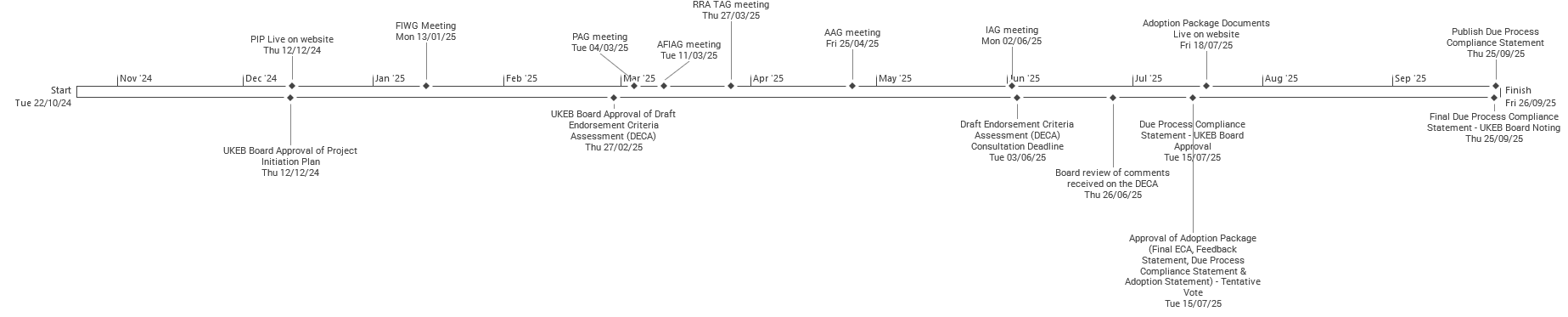
A33The proposed high-level project timeline is shown below. This provides a best estimate based on information known at this time. If necessary, a revised PIP will be presented to the Board, to reflect any material changes, as the project progresses.
| Date | Milestones |
|---|---|
| 12 December 2024 | Draft Project Initiation Plan for Board approval. |
| 30 January 2025 | Technical papers for discussion at Board meeting. |
| 27 February 2025 | DECA for Board approval. |
| Estimated DECA consultation period (90 days): 4 March – 2 June 2025 | |
| 26 June 2025 | Board review of feedback received on the DECA. |
| 15 July 2025 | Consideration of Adoption Package. Board members provide a tentative vote. |
| Second half of July | Voting form sent to Board members. Publication of voting outcome and Adoption Package on the UKEB website. |
| 25 September 2025 | Due Process Compliance Statement for noting. |
Project Initiation Plan: Power Purchase Agreements – Proposed timeline
A34The diagram below is a graphical view of the key milestones and outreach activities described above. It provides a best estimate based on information known at this time, assuming the publication of the final Amendments in December 2024. Future dates are based on current expectations and are, therefore, subject to subsequent modification. The Board will be alerted to any significant changes.
Footnotes
Footnotes
-
The UK's statutory requirements for adoption of international accounting standards are set out in The International Accounting Standards and European Public Limited-Liability Company (Amendment etc.) (EU Exit) Regulations 2019 no. 685 (SI 2019/685). ↩
-
The 'own use' exception applies to certain contracts that would otherwise be accounted for as financial instruments at fair value, and results in these contracts being accounted for as executory contracts. ↩
-
Physical power purchase agreements are contracts for the receipt or delivery of electricity. ↩
-
June 2023 IFRIC Staff Paper Agenda Reference 2. ↩
-
Virtual PPAs are not contracts for the receipt or delivery of electricity. They typically require net settlement of the difference between the fixed contract price and the market price for the contracted volume of electricity. ↩
-
July 2023 IASB meeting staff paper 12, paragraphs 53 – 62. ↩
-
See December 2023 IASB Staff Paper agenda reference 3 and January 2024 IASB General Update Paper 5 Appendix A ↩
-
Although the ED was issued with this title, the IASB project has retained the title Power Purchase Agreements, which is how it is referred to in this PIP. In September 2024, the IASB made tentative decisions on the scope of the Amendments and on the proposals on own-use. In October 2024, the IASB made tentative decisions on the proposals in respect of hedge accounting, disclosures, transition and effective date. ↩
-
September 2024 IASB meeting agenda paper 3A and summary ↩
-
"An entity is a net purchaser if it buys enough electricity in the market in which it buys electricity to offset sales of any oversupply in that same market" - September 2024 IASB meeting summary ↩
-
September 2024 IASB meeting agenda paper 3B and summary ↩
-
October 2024 IASB meeting agenda paper 3A and summary ↩
-
Including for an entity applying IFRS 19 Subsidiaries without Public Accountability: Disclosures ↩
-
"...an entity shall disclose by risk category quantitative information to allow users of its financial statements to evaluate the terms and conditions of hedging instruments and how they affect the amount, timing and uncertainty of future cash flows of the entity." ↩
-
October 2024 IASB meeting vote ↩